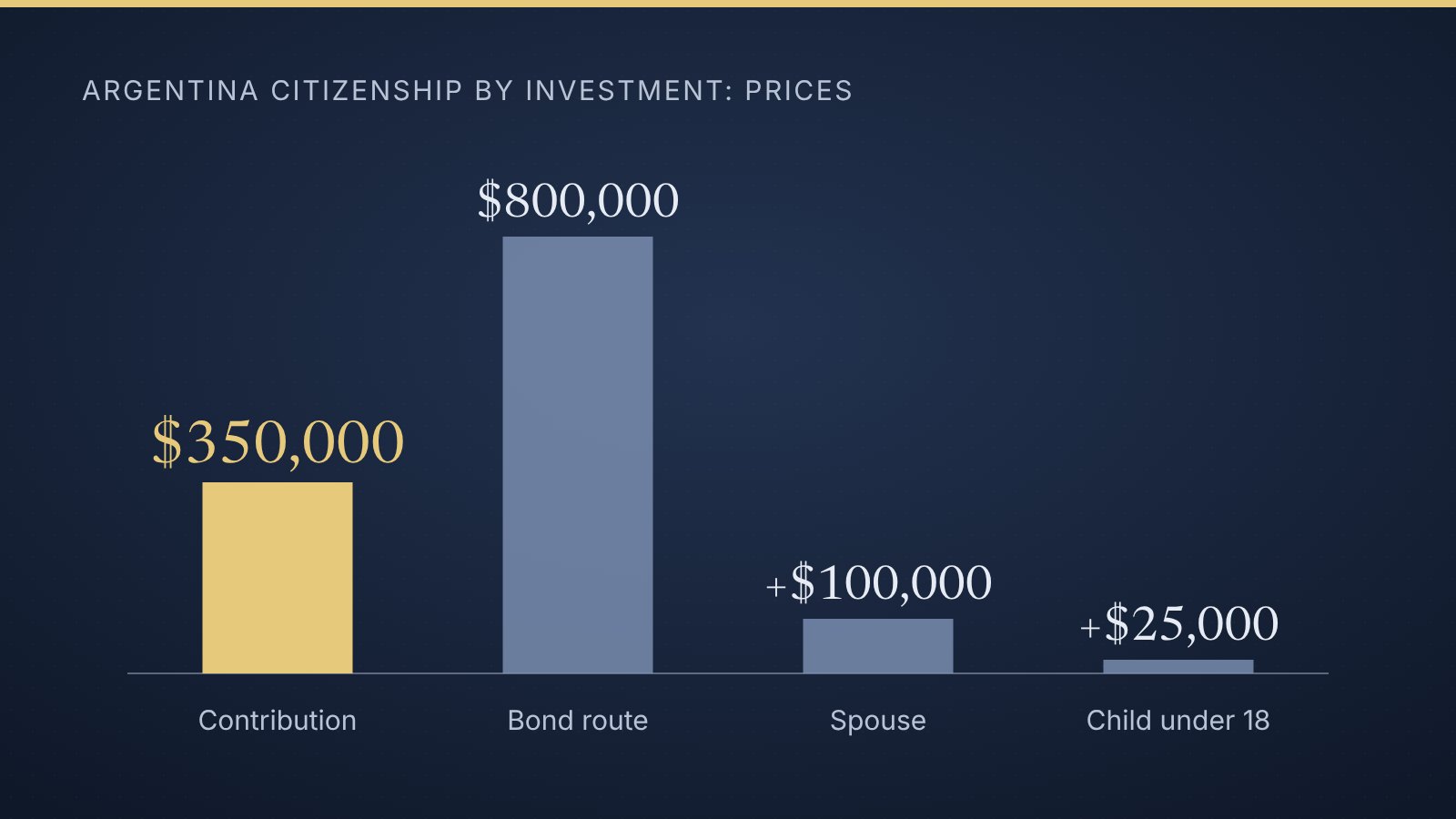
Argentina’s citizenship by investment programme, announced on 2 October 2026, offers Argentine nationality for a non-refundable contribution of $350,000 to the National Treasury, or for $800,000 placed in a government bond created for the programme. As of 1 November 2026, we found no announcement that applications had opened: the government says they will start in the fourth quarter of 2026, and no filing channel, forms or document list had been published when KPMG reviewed the programme on 8 October.
According to Reuters, it would be South America’s first such programme. A residence by investment scheme, like the golden visas of Portugal and Greece, gives a permit to live in a country, and a passport may follow only after years of residence. A citizenship by investment scheme grants the nationality itself, usually without having lived there, and Argentina’s is of this second kind.
What Argentina has announced
Economy Minister Luis Caputo and Cabinet Chief Diego Santilli presented the terms in Paris, during the “Argentina Week” investor event, according to the Buenos Aires Times and MercoPress. Reuters and KPMG report these prices:
- Main applicant: $350,000 as a direct, non-refundable contribution, or $800,000 to subscribe a government bond created for the programme. MercoPress describes it as a seven-year bond.
- Spouse: $100,000.
- Children aged 18 to 25: $100,000 each, if single and without children of their own.
- Children under 18: $25,000 each.
On the contribution route, a couple with two young children would pay $500,000 in total, in KPMG’s example. The sources do not say whether the family amounts differ on the bond route. Money must come through the formal financial system and meet anti-money laundering rules.
An older figure still circulates: in May 2025, before any decree, iProfesional reported a draft threshold above $500,000. The decrees set no price.
The legal basis: two decrees from 2025
The programme does not rest on a law passed by Congress. Decree 366/2025, published on 29 May 2025, is an emergency decree (a decree with the force of law that the president may issue in exceptional circumstances). It amended Citizenship Law 346 of 1869 so that a foreigner who makes a “relevant investment” can naturalise regardless of time spent in the country, and created an Agency for Citizenship by Investment Programmes within the Ministry of Economy, according to Chequeado.
Decree 524/2025, published on 31 July 2025, set the procedure, as Infobae reported. The agency checks the investment, then asks the security ministry, the financial intelligence unit, the intelligence service and others whether the applicant poses a risk. If any of them advises against, the agency proposes rejection. The National Directorate of Migration then has 30 business days to grant or refuse citizenship. The Ministry of Economy defines what counts as a relevant investment.
What is still unpublished
- The opening date and procedure. KPMG listed the start date, platform, forms, document checklist and payment instructions as not yet published on 8 October.
- The bond. Its currency, interest and repayment terms are not in the sources we read.
- Who runs it. The Ministry of Economy launched an international tender on 5 December 2025 for a four-year service to design, launch and promote the programme. Resolution 522/2026 of 14 April 2026 cancelled it after two losing bidders challenged the recommended award, according to lawyer Paula Carello and the trade site IMI Daily. The agency got an unpaid executive director from 22 April (Decree 285/2026).
- Revenue. A consortium of investment firms advising the government estimates up to about $2.5bn if the expected number of applicants comes, according to the Associated Press and MercoPress. We found no official forecast.
The court risk
According to Chequeado, two appeal courts ruled against the decree’s citizenship changes in June 2026, in cases about ordinary naturalisation. On 18 June, a chamber of the federal civil and commercial appeals court found that the exceptional circumstances needed to change citizenship rules by decree had not been shown. On 30 June, the National Electoral Chamber declared the decree null, noting that citizenship carries political rights and the Constitution bars such decrees on electoral matters. The government appealed, and the Supreme Court had not ruled as of 9 October.
Neither case attacked the investment route directly, but it sits in the same decree. Opposition deputies have filed bills to repeal it; no vote has been reported.
Why Argentina is doing it, and what it means for a family
The government says the money will strengthen its “fiscal and financial position”, and MercoPress notes large foreign-currency debt payments due in 2027. Caputo says the passport is accepted in “more than 140 countries”. Abroad, the climate is cooler: as MercoPress recalls, in April 2025 the EU Court of Justice ruled Malta’s citizenship programme unlawful, and the Financial Action Task Force has warned such schemes can help hide identities and money.
For a family, compare it with a golden visa. In Portugal, €500,000 goes into funds that must be held for five years but remain the family’s asset; in Argentina, $350,000 is gone on day one. The bond route may keep the capital, but it ties $800,000 to the Argentine state’s ability and willingness to repay, on terms not yet published. A passport also does not decide where you pay tax: that depends on residence and each country’s rules. Our residence routes for investors table compares other options.
A fair caveat
This post reflects sources read by 1 November 2026: Reuters, Argentine media and adviser notes, not the decrees themselves in the Boletín Oficial. Prices, bond terms and even the legal basis may change before the first application is filed.
Five lessons to take away
- Announced is not open. As of 1 November 2026, we found no way to apply yet.
- The cheap route is a gift. The $350,000 contribution is non-refundable.
- The bond route is a credit bet. Its terms are unpublished, and it carries Argentine sovereign risk.
- A decree can fall in court. Two appeal courts have already ruled against the decree’s citizenship changes.
- Citizenship is not tax residence. Where a family pays tax is a separate question.
Questions to bring to your advisors
What would a second nationality do for us that a residence permit cannot? Does our home country allow dual citizenship? If the Supreme Court strikes down the decree, what happens to passports already granted? Can we document the source of every dollar? How would the bond be valued, taxed and repaid? These are questions to bring to your lawyers and tax advisors, not advice.