In the examples published so far, family offices use artificial intelligence for paperwork and back-office work, not for picking investments. On 28 October 2026 FOTechHub, which runs a community and AI training programmes for family offices, described in Family Capital what some early adopters have built. None of the offices is named.
What the early adopters have built
The examples, as FOTechHub describes them:
- PDF to ledger. A staff member who does not code built a flow of about 30 steps in a low-code tool that turns PDFs into import files for the accounting system. AI handles three of the steps. Twenty such flows are in production.
- An in-house system with nightly checks. An accounting manager spent five years building an internal system. It pulls live data from several systems, serves a web app to colleagues and the family, and runs a reconciliation every night that posts matches and flags exceptions. It replaced a process that took about half a working day.
- Tax paperwork. Tools that gather US K-1 forms (the form that reports a partner’s share of a partnership’s income), and tax research tools that answer only from verified legal sources.
- Document inboxes. Inboxes that collect capital calls (a fund’s requests for money an investor has committed) and quarterly reports, plus overnight digests of investment statements.
- A searchable archive. One firm ran more than 1 million documents through text recognition, then split, renamed and tagged them into about 60 types, tagging only when confidence was high. Search follows the permissions staff already have.
- Cleaner records. AI restores transaction descriptions that the accounting platform’s automation strips out.
- Reports as web pages. Quarterly reviews are built as HTML sites from the portfolio system’s data, instead of slide decks.
The rule most offices share
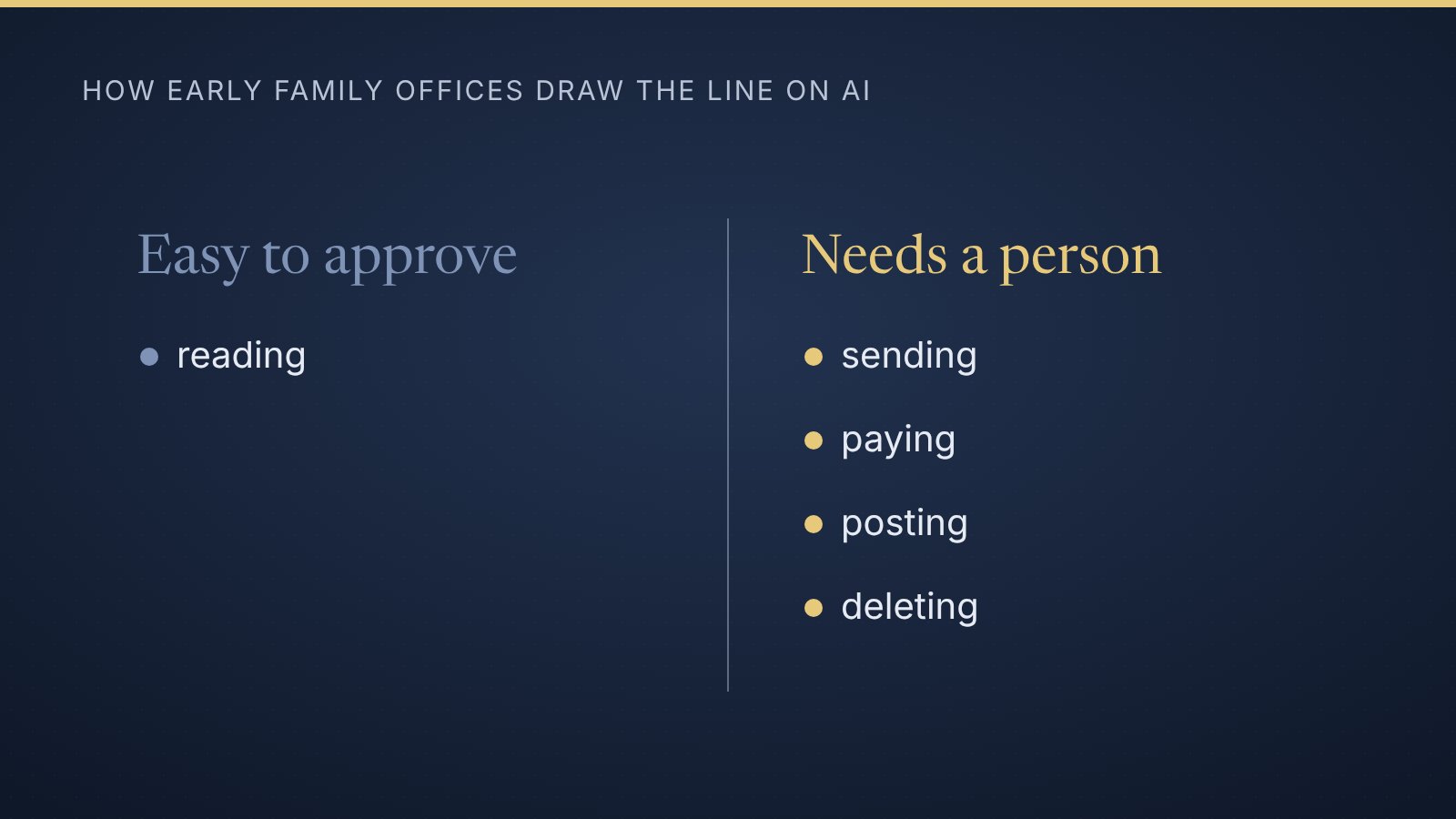
Almost every office draws the same line, the article says: “reading is easy to approve; anything that sends, pays, posts, or deletes needs a person.” Offices govern the tools in different ways, and the article says none of the approaches is the only right answer. On building versus buying, it says the deciding cost is redesigning the process, not the headline price of the software.
For a small office, the rule is a practical starting point: let the tools read, sort and draft, and keep a person on every payment, message and deletion. For context on staffing and budgets, see what running a family office costs and single versus multi family offices.
What to watch
- FOTechHub’s 4th Annual Family Office Tech & Ops Conference, online on 18 and 19 November, free for family offices and advisors, where it plans to launch a library of use cases.
- Whether offices start publishing measured results: hours saved, errors caught, costs.
- Whether more offices let AI act, not just read, and what controls they put in place.
A fair caveat
The examples are anecdotes from FOTechHub’s own community and programmes, and the article, written by FOTechHub, also promotes its training and its conference. It gives no survey, sample size, costs or measured savings beyond the half-day example, and we could not check any example independently.
Questions to bring to your advisors
Which of our routine tasks are mostly reading and sorting? Who approves anything that leaves the office or moves money? Who owns the data and the permissions if staff build their own tools? These are questions to bring to your advisors, not advice.