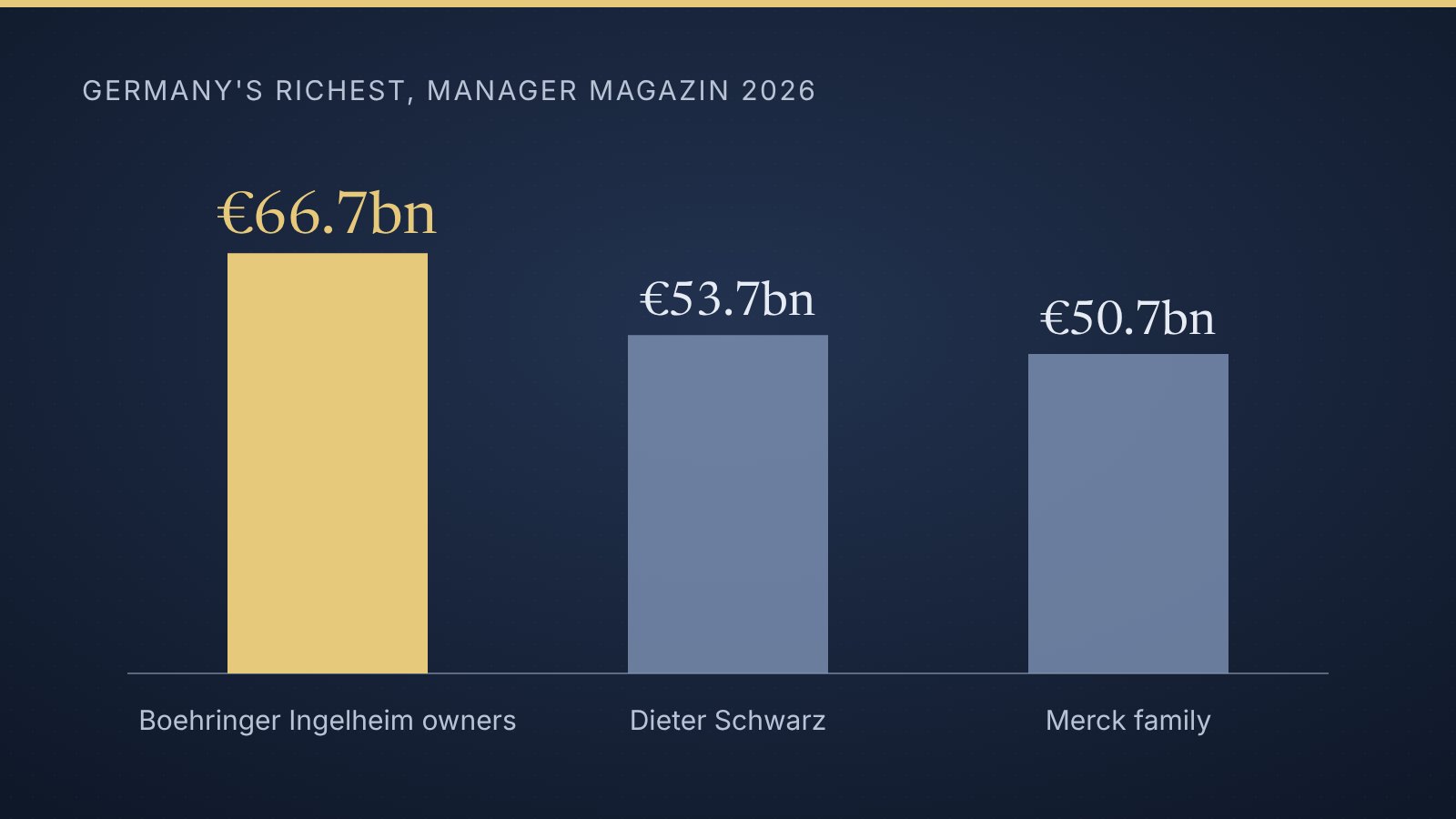
The Boehringer family, which owns the German drugmaker Boehringer Ingelheim, is Germany’s richest in 2026, according to manager magazin’s annual list of the 500 richest Germans. Its branches include the von Baumbach family. The magazine estimates the family’s fortune at €66.7bn, ahead of Dieter Schwarz, the owner behind Lidl and Kaufland, at €53.7bn, and the Merck family at €50.7bn. It is the first time a pharmaceutical family has led the ranking, Joyn Newstime reported.
More useful is what sits underneath. The top three hold their wealth in three different ways: a private company owned outright, a listed company controlled through a family partnership, and a charitable foundation. We could not open the ranking itself, so all figures are the magazine’s estimates as reported by Joyn Newstime, Euronews and Leinetal24 in early October 2026.
The 2026 ranking: who is in the top five
According to manager magazin, as reported by Joyn Newstime and Euronews:
- The Boehringer Ingelheim shareholder families: €66.7bn.
- Dieter Schwarz (Schwarz Gruppe: Lidl, Kaufland and others): €53.7bn, up €7.2bn in a year.
- The Merck family (Merck KGaA): €50.7bn.
- Susanne Klatten and Stefan Quandt (BMW, Altana and others): €33.3bn, down €2.8bn.
- The Albrecht and Heister families (Aldi Süd): €29.8bn.
Joyn Newstime names the rest of the top ten: Andreas von Bechtolsheim of Arista Networks (€27.7bn), a newcomer there, then the Reimann (JAB Holding), Henkel, Albrecht (Aldi Nord) and Hasso Plattner families. It puts the top 100’s combined wealth at almost €784bn, up 3.4%.
Why Boehringer Ingelheim is new at number one
Part of the change is about disclosure, not growth. Euronews and Leinetal24 report that the Boehringer family was left out of earlier editions under an old agreement and is now officially listed. Dieter Schwarz, first in 2024 and 2025, did not get poorer: his estimate rose by €7.2bn. No report we saw gives a prior-year figure for the Boehringer families.
Boehringer Ingelheim: a private company the family owns outright
Albert Boehringer founded the company in Ingelheim am Rhein in 1885. It is not listed and belongs entirely to the founding family, whose branches include the Boehringer and von Baumbach families. The parent company is C.H. Boehringer Sohn AG & Co. KG.
The name describes the structure. A KG is a limited partnership: limited partners own a share and risk only their stake, while a general partner runs the business with unlimited liability. “AG & Co.” means that general partner is a stock corporation, so no family member carries the unlimited liability personally.
In 2025 the group had net sales of €27.8bn, up 7.3% at constant exchange rates, and spent €6.4bn on research and development, according to the company’s annual results.
Full private ownership is the simplest model: no outside shareholders and no takeover risk. The cost is that every branch’s wealth sits in one unlisted company, with no market where a relative who wants out can sell.
Merck: the family as general partner of a listed company
Merck traces its roots to a Darmstadt pharmacy taken over by Friedrich Jacob Merck in 1668. It is not the American Merck & Co., a former subsidiary. The founding family is in its 13th generation, according to the company.
The listed company is Merck KGaA, a partnership limited by shares. Merck explains that in a KGaA the general partners run the business and are personally liable, while the limited shareholders risk only what they put in.
The family holds around 70% of Merck KGaA’s total capital through E. Merck KG, the general partner, and owns 99.9% of E. Merck KG. The remaining shares have traded in Frankfurt since 1995 and are in the DAX index.
Family decisions run through dedicated bodies. A Family Board, elected from the family by the partners’ meeting, sets strategy. It elects a Board of Partners of five family and four outside members, comparable to a supervisory board, which appoints the Executive Board.
Henkel, eighth on the list, also uses a KGaA, combined with a contract that binds the family’s votes: see how the Henkel family share pool keeps control. The French equivalent, the SCA, is the form the Arnaults chose for Agache, the holding company that controls LVMH.
Schwarz Gruppe: a foundation holds the capital
Dieter Schwarz built Lidl and Kaufland into the Schwarz Gruppe, which had revenue of more than €175bn and more than 595,000 employees in 2024, according to Joyn Newstime.
Schwarz does not hold the group in his own name. In 1999 he transferred his assets to the charitable Dieter Schwarz Stiftung, CIO.de reported in 2021, citing manager magazin; the foundation is funded from the companies’ payouts through Schwarz Beteiligungs GmbH. A 2018 Leinetal24 report put the foundation’s share of the capital at 99.9% and said the founder kept the last word. Lidl belongs to a partnership, Schwarz Unternehmenstreuhand KG.
Bosch uses a similar split, as we described in Holding Structures in Plain English: a foundation holds most of the capital and a separate partnership most of the votes. At Schwarz, how votes are split is only partly public. A foundation has no owners, so heirs have no shares to divide or sell.
A fair caveat
Rich lists are estimates. For unlisted firms such as Boehringer Ingelheim and the Schwarz Gruppe, the magazine has to value the business itself, and another method could move the number by billions. Euronews reports that the Merck family’s estimate more than doubled in a year, from €24.5bn, and links part of the rise to Merck’s electronics business. And such a “fortune” often belongs to a foundation or a company, not to one person.
Five lessons to take away
- The ownership form shapes the fortune. Wealth behaves differently in a private company, a listed partnership or a foundation.
- Full private ownership buys freedom, not liquidity. Boehringer answers to no outside investors, and its owners have no market for their stakes.
- A partnership limited by shares admits outside money without losing control. Merck’s family keeps about 70% of the capital.
- A foundation removes the inheritance question. With no owners, there are no shares for heirs to split.
- Write the family’s rules into bodies, not habits. Merck’s boards let a 13th generation decide together.
Questions to bring to your advisors
If our company passed to the next generation tomorrow, who would own it, who would decide, and could anyone sell? Would a private partnership, a listed partnership or a foundation fit our goals? How would German inheritance tax relief for business heirs, now before the Federal Constitutional Court, apply to us? These are questions to bring to your lawyers and tax advisors, not advice.
