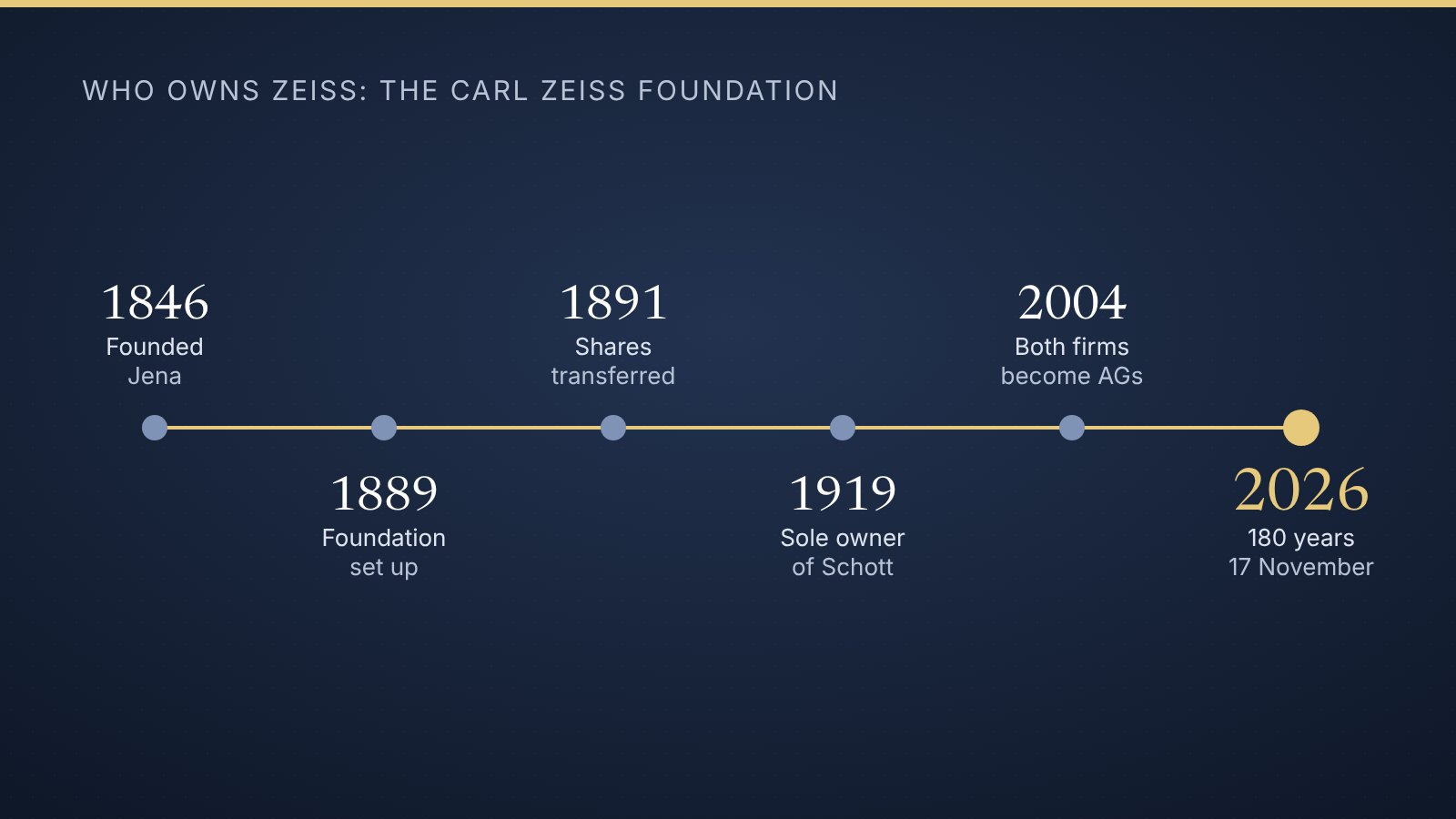
ZEISS is owned by a foundation, not a family. The Carl Zeiss Foundation (Carl-Zeiss-Stiftung) is the sole shareholder of Carl Zeiss AG and of the glassmaker SCHOTT AG, and its statute generally bars it from selling those shares. ZEISS turns 180 on 17 November 2026: Carl Zeiss opened his optics workshop in Jena on that day in 1846.
For families, ZEISS shows how a business can leave private hands for good, and at what cost.
How Ernst Abbe Gave ZEISS to a Foundation
Ernst Abbe, a physicist, became Carl Zeiss’s partner in 1875. In 1884 Abbe, Otto Schott, Carl Zeiss and his son Roderich founded the Jena glassworks that became SCHOTT. Carl Zeiss died in December 1888, and on 19 May 1889 Abbe set up a foundation named after his late partner.
In 1891 Abbe brought his shares in both companies, and those of Roderich Zeiss, into the foundation. In 1919 Otto Schott handed over his shares, making the foundation sole owner of the glassworks.
By the foundation’s own account, Abbe wanted two things: to secure the companies and their staff for the long term, which he believed required taking ownership out of personal hands, and to use the profits to fund science.
From Owner-Operator to Sole Shareholder
Germany’s post-war division split the foundation and its companies between East and West until reunification. In 2004 ZEISS and SCHOTT were spun off into independent stock corporations (AGs), with the foundation as sole shareholder.
In the fiscal year to 30 September 2025, the ZEISS Group reported revenue of €11.9 billion and 46,622 employees. That year the foundation received €80 million in dividends from its two companies, about 80% of its income (our calculation); it funds research and teaching in STEM fields.
What Foundation Ownership Means
The statute allows a sale or outside shareholders only to avert a threat to a company’s existence, and only if all members of both governing bodies agree. No dividend is paid while a company’s group equity ratio is 20% or less. The ban covers only the foundation’s own shares: Carl Zeiss AG holds about 59% of listed Carl Zeiss Meditec.
No heirs can divide the shares, and no buyer can take over. But no one can cash out, and control sits outside any family: a three-member Shareholder Council votes the shares, and the ministers responsible for universities in Baden-Württemberg and Thuringia form the Foundation Administration. Compare the trusts that own most of Tata Sons and the foundations behind Bosch and Novo Nordisk.
A fair caveat
The history and Abbe’s motives come from the foundation’s and ZEISS’s own pages: primary sources, but interested ones. A structure designed in 1889 and rebuilt in 2004 cannot simply be copied into another country’s law.
What to watch
- 17 November: unlike in 2021, ZEISS plans no further central activities; countries and units may mark the day.
- ZEISS’s results for the year to 30 September 2026, and the foundation’s dividend.
- Carl Zeiss Meditec, where Bronwyn Brophy O’Connor becomes CEO in December 2026.
Questions to bring to your advisors
If we wanted our business never to be sold or split among heirs, which structures would allow that in our country, and who would control it? These are questions to bring to your advisors, not advice.