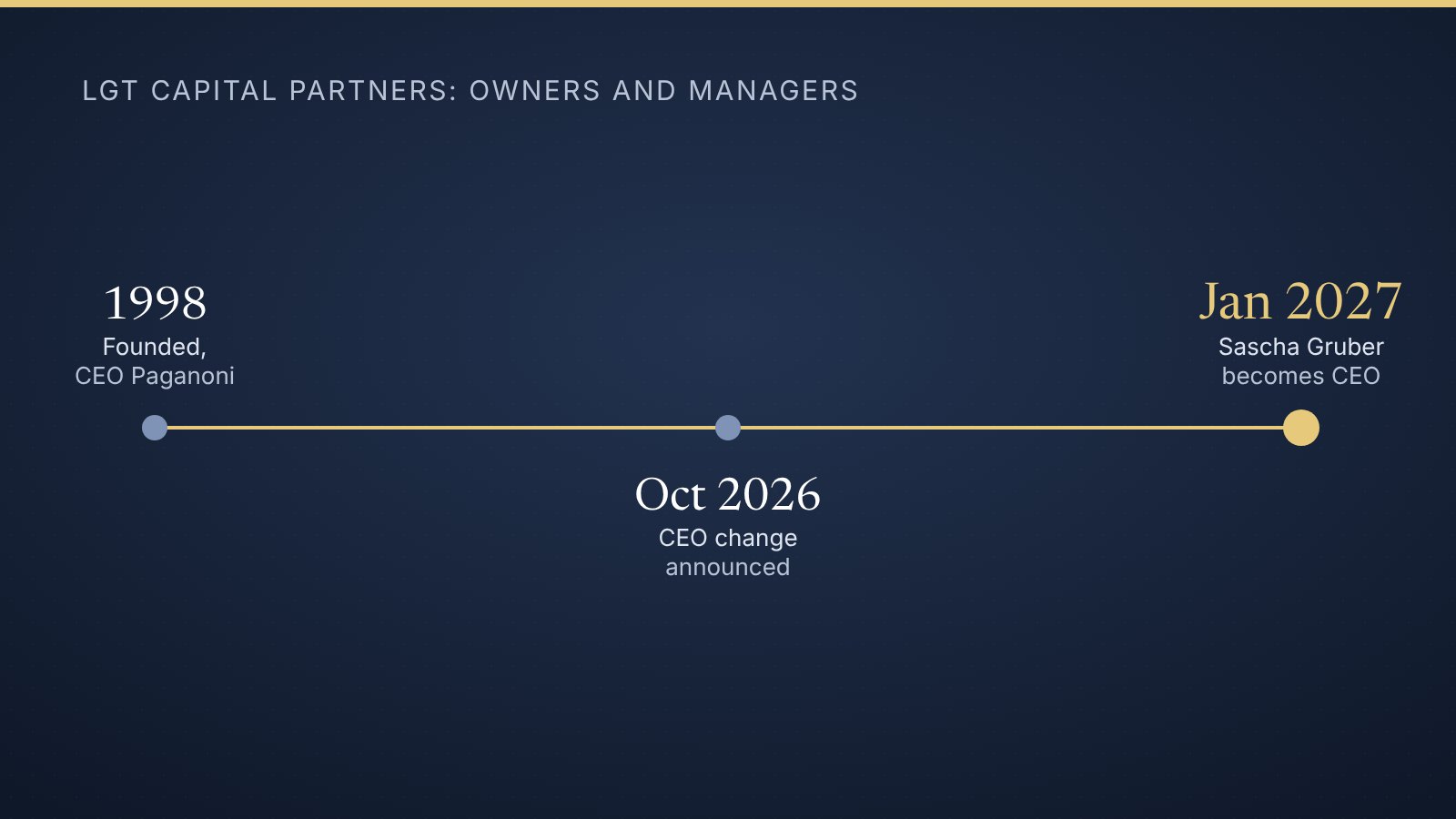
LGT Capital Partners, a private markets manager with more than $120bn under management, is privately owned by Liechtenstein’s Princely Family, according to its website. On 29 October 2026 the firm said Sascha Gruber will become chief executive on 1 January 2027, subject to regulatory approval, finews.ch reported. He takes over from Roberto Paganoni, who has led the firm since it was founded in 1998 and moves to its Group Holding Board.
The change is a useful example of how a family owner can keep ownership for generations while hiring professionals to run the business.
Who Owns LGT
In May 2020, LGT announced that it would split into three independent businesses: LGT Private Banking, LGT Capital Partners and Lightstone, an impact investor. All three “will in future be held directly by the Prince of Liechtenstein Foundation,” LGT said, and the group structure would be dissolved, with the new set-up starting in 2021. Prince Max von und zu Liechtenstein, group CEO since 2006, became chairman of all three; LGT Capital Partners’ website still lists him as chairman. The Princely Family is also Liechtenstein’s ruling house; this post looks only at the business.
A foundation is a legal entity with no shareholders: it holds assets for purposes set by its founder and is run by a foundation board. Our holding structures explainer covers how foundations work, and the Liechtenstein guide covers its foundation law and tax rules.
Owners Who Hire Managers
Paganoni has been chief executive for 28 years. Gruber has worked at the firm since 2002, has sat on its executive management for many years and helped shape its private markets and secondaries business and its expansion in North and South America, according to finews.ch. The existing strategy is to continue.
The firm grew under hired management. In 2020, LGT said LGT Capital Partners had around CHF 60bn of assets and about 500 employees. It now reports more than $120bn, more than 750 institutional investors and about 1,000 staff in 16 locations, with headquarters in Pfäffikon, in the Swiss canton of Schwyz (see our Switzerland guide). The two asset figures are in different currencies, so they show scale, not an exact growth rate.
The pattern is old: owners keep the capital and the board seats, and long-serving managers run the business. Sumitomo’s hired manager Iba Teigo is a historical example. Moving the outgoing CEO to the board can keep his knowledge close, as long as roles stay clear.
A fair caveat
The figures come from the firm’s announcement as reported by finews.ch; we did not read the release itself. The foundation holding is as LGT described it in 2020; the firm’s current pages say only that the Princely Family owns it. The foundation’s internal rules are not public, and we make no estimate of the family’s wealth.
What to watch
- Regulatory approval of Gruber’s appointment before 1 January 2027.
- Any further changes to the executive committee as Gruber takes over.
- Whether LGT Capital Partners keeps expanding in the Americas.
Questions to bring to your advisors
If our family owns a business through a foundation, who appoints the chief executive, and what role should a long-serving CEO keep after stepping down? These are questions to bring to your advisors, not advice.