Premium financing is buying a life insurance policy with borrowed money: a lender, usually a bank, pays a large part of the premium, and the buyer pledges the policy as collateral. In Hong Kong it made up about 36% of new business premiums in the first half of 2026, up from about 21% a year earlier, The Standard and Zhitong Finance reported on 20 August; Zhitong cited the Insurance Authority (IA).
That day the IA warned life insurers about leverage, early cancellations and one-sided sales material, and said it would run another joint inspection with the Hong Kong Monetary Authority (HKMA) in the second half of 2026.
How Premium Financing Works
The IA defines premium financing as borrowing from a lender, usually a financial institution, to pay premiums, while assigning all or part of the policy’s rights to that lender. The family pays part of the premium itself, and the bank lends the rest against the policy’s surrender value: what the insurer would pay if the policy were cancelled. The loan is repaid later from the policy, other assets or the death benefit.
In Hong Kong the usual product is a whole life participating policy, the IA says. “Participating” means part of the return comes from non-guaranteed bonuses the insurer sets from its own results.
Why Families Borrow to Buy Life Cover
A large policy can be a tool for passing wealth on. Policygenius, a US insurance broker, says premium financing is typically used by people with $5 million or more in assets, inside an estate plan. The payout gives heirs cash for estate taxes without selling a business, while the family’s own capital stays invested. Cash can also balance an estate where one child inherits the company.
Hong Kong has had no estate duty since 2006, as our Hong Kong guide explains, so the tax motive matters mainly for families with assets or heirs elsewhere. The IA describes Hong Kong’s market differently: financed policies are commonly used for wealth management, some for short-term interest rate arbitrage, earning the gap between policy growth and the loan rate. Policies are often held through a trust or holding company.
A Worked Example: When the Spread Turns
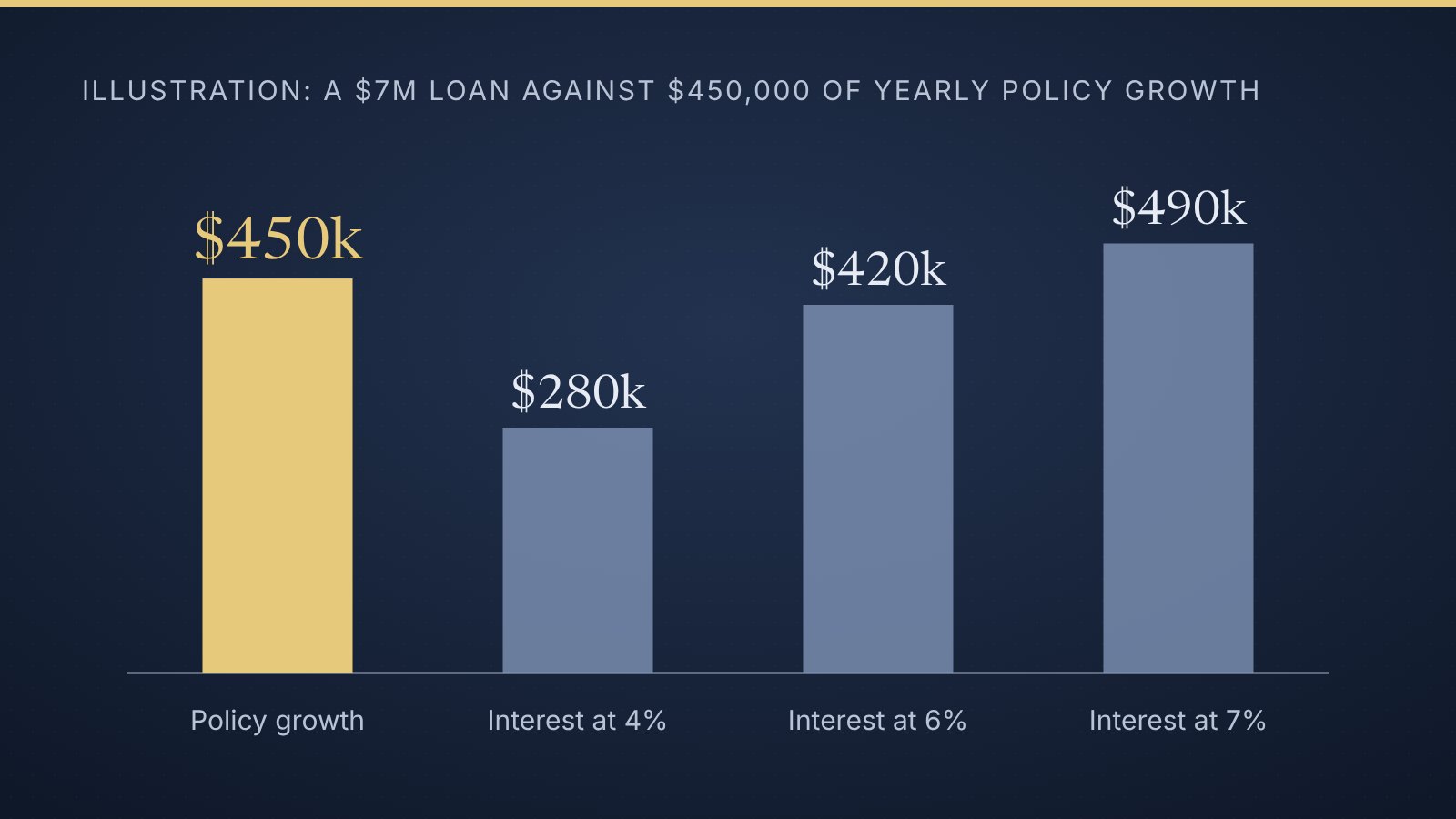
Illustration, not a quote. A family buys a policy with a single premium of $10 million. It pays $3 million and borrows $7 million. Assume the policy grows by 4.5% a year, or $450,000.
- At 4% interest, the loan costs $280,000 and the family keeps $170,000 a year: about 5.7% on its own $3 million, against 4.5% without borrowing.
- At 6%, interest is $420,000 and the family keeps $30,000, or 1%.
- At 7%, interest is $490,000 and the family loses $40,000 a year, before fees.
The break-even rate is about 6.4%. Rates and yields topped the risks in a Deutsche Bank family office poll this year.
Early surrender is the second trap. In the first years many policies are worth less than the premium paid. If the family surrenders and receives $8.5 million, it repays $7 million and keeps $1.5 million: half its own money, before interest. A 15% shortfall on the policy becomes a 50% loss for the family. It is the same mechanism as a loan against shares: the lender’s claim is fixed, so the borrower absorbs every fall.
What Hong Kong’s Insurance Authority Found
The circular of 20 August 2026, signed by Marty Lui, executive director for long term business, and Alan Wu, acting head of conduct supervision, says:
- For some insurers premium financing has become “the major source of new business sales”, and for some products financed policies exceed 80% of the count or premiums.
- Financed buyers often surrender once a target return is reached or the loan term ends. Products built on “low lapse assumptions” may then lose money.
- Insurers should not rely mainly on cutting non-guaranteed bonuses to absorb those losses, because policyholders who did not borrow share the same fund.
- Bigger premium discounts, higher “Day 1” surrender values and high loan-to-surrender value ratios push leverage up. Reviews found sales material suggesting up to nine times leverage from a 10% contribution.
- Under stress, concentrated financing could lead to “correlated asset sales at depressed prices”, especially of less liquid assets.
The IA expects insurers to keep products under review, make sales and training material “well balanced, without overemphasizing the leveraging benefit”, strengthen lapse and economic stress tests, and disclose adverse-scenario losses clearly and prominently.
The Rules Already in Place
Since 1 January 2023, under an IA circular of April 2022, the intermediary must check that the customer can pay the unfinanced part, meet every repayment, and repay the whole loan if the lender demands it early. The customer signs an Important Facts Statement on premium financing before issue. If an early demand could only be met by cashing in the policy, the sale should not be recommended without a documented reason.
Banks have their own rules. In November 2025, according to a summary by the law firm Timothy Loh, the HKMA told banks to present financing as a separate payment option, not to sell it as a return booster, and to match loan terms to the policy, for new facilities from 1 January 2026.
A fair caveat
The 36% figure comes from press reports (Zhitong Finance attributes it to the IA): the circular gives no market-wide number, and we could not open the underlying statistic. The worked example uses invented round numbers; real policies carry fees, surrender charges and changing bonuses. As far as we could find, no findings from the new joint inspection had been published as of 1 November 2026.
Five lessons to take away
- The spread is the whole bet. The arrangement pays only while the policy grows faster than the loan costs.
- Leverage works both ways. A small fall in policy value can wipe out much of the family’s own money.
- Early exits are expensive. Surrender values in the first years can sit below the premium paid.
- Bonuses are not promises. Non-guaranteed benefits can be cut when other policyholders leave.
- Plan for the lender’s call. Know how the loan would be repaid in full if the bank asked tomorrow.
Questions to bring to your advisors
What must the policy earn to cover the loan at today’s rate, and at two points higher? What would we get back if we surrendered in each of the first five years? Can the bank demand repayment, and from what would we pay? Who should own the policy, and how does the payout fit our estate plan? These are questions to bring to your advisors, not advice.
