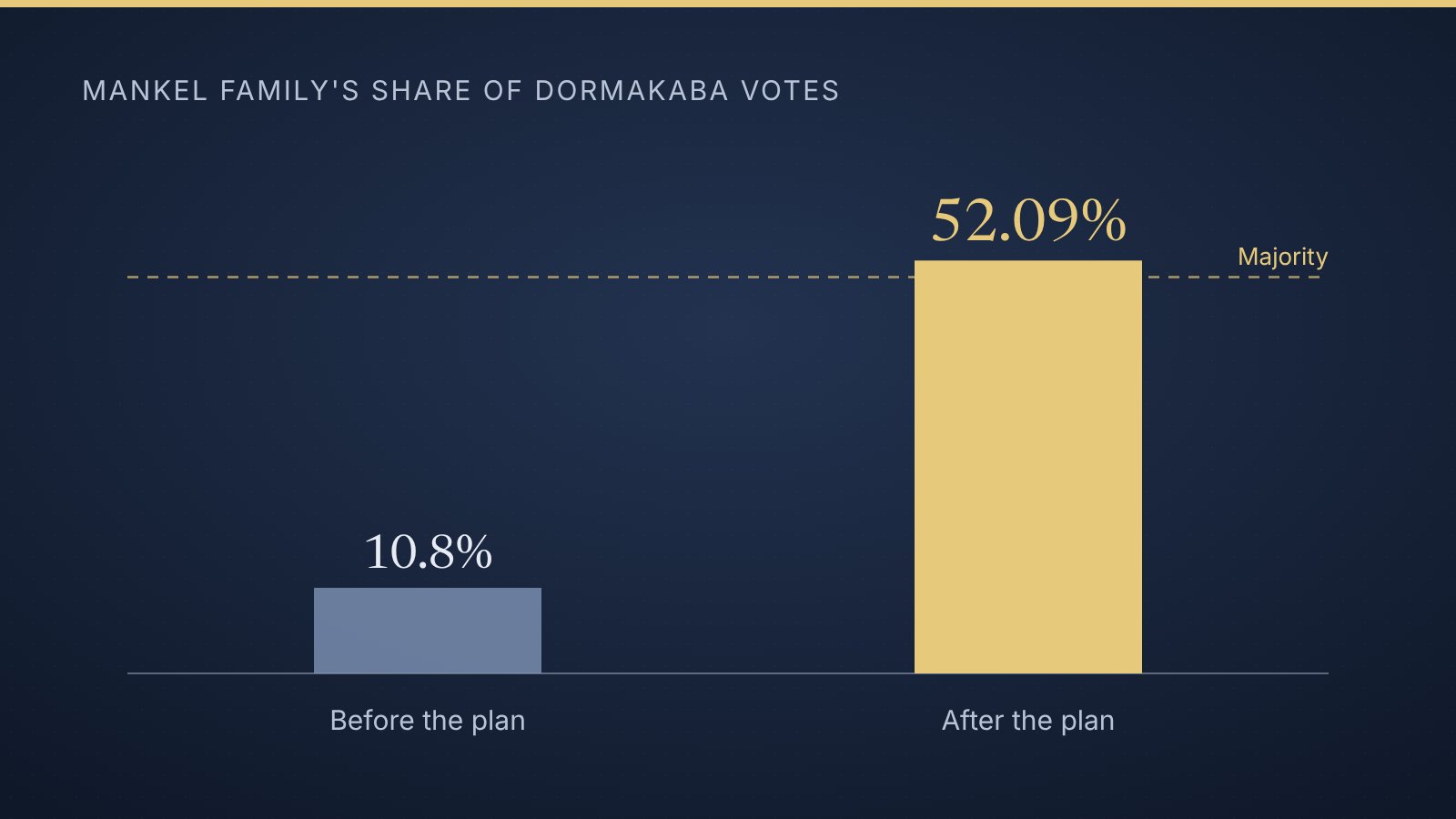
On 1 September 2026, dormakaba, the Swiss-German maker of locks and door systems, proposed to rebuild the ownership structure it has had since Dorma and Kaba merged in 2015. The Mankel family, the former owners of Dorma, would hand the listed company its 47.5% stake in the group’s operating business, valued at CHF 2.13 billion, and take new shares in return. The family would end up with 52.09% of dormakaba Holding AG, a clear majority. In exchange, it accepts a 57% ceiling for 15 years and a limit on its board seats.
The plan needs shareholder approval at the annual general meeting scheduled for 20 October 2026; as of 15 October 2026 the vote had not yet taken place. Update: on 20 October 2026, shareholders approved all of the board’s proposals, as we report in our post on the vote and the next steps. It is a clean example of a family trading one kind of ownership for another, and of what it gives up to gain control.
How two family firms ended up in two tiers
Kaba began in 1862, when Franz Bauer set up a locksmith shop and cash-register factory near Zurich. Dorma began in 1908 as Dörken & Mankel KG in Ennepetal, Germany. When they merged in 2015, they did not pour everything into one company. According to dormakaba’s 2023/24 corporate governance report, the listed dormakaba Holding AG owns 52.5% of a German intermediate company, dormakaba Holding GmbH + Co. KGaA, and the Mankel family (the report calls it the Mankel/Brecht-Bergen family) owns the other 47.5%. It also holds 10.8% of the listed company itself, according to the September 2026 release.
That is a two-tier structure: an owner holds part of the top company and a direct stake in the company below it. (For the basic building blocks, see Holding Structures in Plain English.)
Why dormakaba’s structure was hard to read
- A share did not own the whole group. The company says each dormakaba share represents only 52.5% of the economic interest in the operating business.
- Economics and votes pointed in different directions. By our calculation, the family’s direct 47.5% plus its share of the listed company’s 52.5% gives it about 53% of the group’s economics, an “economic majority” in the company’s words. Yet in the listed company, where the board is elected, it has 10.8% of the votes.
- Side agreements did the rest. Since 2015 the Mankel family and the Kaba family shareholders have voted together in a pool. In mid-2024 the pool held 27.9% of the listed company and could propose up to five board members. A separate transfer agreement allowed the Mankel family, if an outsider gained a third or more of the votes in the listed company, to buy back 2.6% of the German companies and regain 50.1% of them. In plain terms, a bidder for dormakaba could lose control of the business it was buying.
The chairman, Svein Richard Brandtzæg, said the change would make the group “easier to understand and compare” and should, over time, remove any valuation discount linked to the current set-up.
How the two-tier structure would be collapsed
The fix is a contribution in kind: the family transfers an asset (its 47.5%) to the company and receives new shares instead of cash.
- Price: CHF 2.13 billion for the 47.5% stake.
- Payment: 36,161,560 new dormakaba shares at CHF 58.0989 each (about CHF 58.10), based on the 30-day volume-weighted average share price, plus CHF 29.9 million in cash.
- Result: the family would hold 40,711,762 shares, or 52.09% of shares and votes, and each dormakaba share would represent 100% of the group’s economic interest instead of 52.5%.
By our calculation, the family’s economic share barely moves, from about 53% to 52%. What changes is where it sits: all of it in the listed company, with voting control to match.
The company also expects about CHF 2 billion of “capital contribution reserves from foreign sources”, which can be paid out later without Swiss withholding tax.
What the Mankel family gives up
Under Swiss rules, a shareholder who crosses one third of the votes of a listed company must normally offer to buy out everyone else. A new opting-out in dormakaba’s articles, which the Swiss Takeover Board confirmed as valid on 31 August 2026, would exempt the Mankel family. The price for that, and for majority control, is a relationship agreement dated 31 August 2026 that takes effect on completion:
- A ceiling. For 15 years, the family will not go above 57% of shares and votes, so at least 43% stays with other shareholders.
- Board limits. The family may nominate no more than half of the board, which is set to shrink from 10 members to 8.
- An independent chair with the casting vote. In a tied board, the independent chair decides.
The 2015 pool agreement and related side deals end at completion, and so does the transfer agreement in the Mankel family’s favour. The Kaba family’s 7,076,550 shares, about 17% of the company today by our calculation, would equal 9.05% after the new shares are issued and would count as free float.
Henkel shows the opposite path: there, a family share-pooling agreement is still the main tool of control after 150 years. At dormakaba, the pool ends because one family gets a direct majority.
A fair caveat
Shareholders approved the plan on 20 October 2026; it still needs regulatory approvals, which the company has not named, before completion, expected on or around 7 January 2027. The full relationship agreement is not public, and our figures for the family’s current economic interest and the Kaba stake are calculations, not company statements. Whether the discount disappears is for the market to judge.
Five lessons to take away
- A merger structure can outlive its purpose. What suited two families in 2015 was hard to read by 2026.
- Economic ownership and control are different things. The family’s economic share barely moves, but its votes rise from 10.8% to 52.09%.
- Control has a price. Here it is a 57% ceiling, a board limit and an independent chair.
- Simpler can be cheaper. The company expects less tax leakage and a smaller discount.
- Side agreements need an exit plan. The pool and the takeover defence end on the day the new structure begins.
Questions to bring to your advisors
If our family owns a business at more than one level, can an outsider see who owns what? What would it cost, in tax and in rights given up, to collapse it into one level? If we gained control of a listed company, which promises would other shareholders expect, and for how long? These are questions to bring to your advisors, not advice.
