Scott Kirby, the chief executive of United Airlines, told The New York Times in an interview reported on 18 October 2026 that the United States needs a national wealth tax and inheritance taxes that “get close to 100 percent at some level.” He added: “I would pay them.” It is a personal opinion, not a bill.
It is a good moment to see how America taxes estates today. The federal estate tax only reaches the part of an estate above $15 million per person in 2026, at a top rate of 40%, and only a tiny share of estates pay it.
What Scott Kirby Said, and What He Did Not
According to Fox Business, the remarks came in answer to a question about falling public trust in business leaders. Kirby said that “wealth inequality has become a danger to our society,” and that a wealth tax had to be national: it “won’t work by state because people will just move.”
He named no exact rate, no level at which the near-100% rate would start, and no draft law. Other proposals are more concrete. In March 2026 Senator Bernie Sanders and Representative Ro Khanna introduced the Make Billionaires Pay Their Fair Share Act, a 5% yearly tax on billionaires’ wealth, according to CPA Practice Advisor. It has not become law. In California, voters decide on 3 November on Prop 40, a one-time 5% billionaire tax, which tries to stop people leaving by taxing billionaires who lived in the state on 1 January 2026. That is the problem Kirby described.
Wealth Tax, Inheritance Tax, Estate Tax: Three Different Things
The words are often mixed up:
- A wealth tax is charged on what a living person owns, usually every year. Prop 40 and the Sanders and Khanna bill are wealth taxes.
- An inheritance tax is charged on what each heir receives, and the heir pays it.
- An estate tax is charged on the whole estate of the person who died, before it is shared out, and the estate pays it.
The US federal system uses the third kind. The Congressional Research Service (CRS) notes that under today’s estate tax the heirs themselves are not taxed. A federal inheritance tax paid by beneficiaries existed from 1862 to 1870. A few states run their own estate or inheritance taxes on top of the federal one.
How the US Estate Tax Works in 2026
The main rules, from IRS pages and the CRS overview:
- The exclusion. The basic exclusion amount is $15,000,000 per person for deaths and gifts in 2026, up from $13,990,000 in 2025. It was set by the tax law signed on 4 July 2025 (Public Law 119-21), and CRS says it is indexed for inflation after 2026.
- The rate. The rate schedule in the Form 706 instructions tops out at 40%. Because the credit ($5,945,800) cancels the tax on the first $15 million, in practice each dollar above that is taxed at 40%. A $20 million estate with no deductions and no earlier taxable gifts would owe about $2 million.
- Gifts and death share one allowance. Large lifetime gifts use up the same $15 million. Gifts within the annual exclusion, $19,000 per recipient in 2026, do not.
- Spouses. Property passing to a surviving spouse can qualify for the marital deduction. A spouse’s unused exclusion can also pass to the survivor (“portability”), so a married couple can shelter $30 million in 2026. Portability only works if the estate files Form 706 and elects it, normally within nine months of death (extendable by six months); estates below the filing threshold can get up to five years under an IRS relief procedure.
- Heirs’ cost basis. Heirs generally take inherited assets at their value on the date of death, so, as CRS puts it, the gains built up during the owner’s life never bear capital gains tax.
How Many Estates Actually Pay
Very few. CRS counts 2,129 taxable estates in 2019, or 0.07% of deaths, against 5,467 (0.21%) in 2016 before the exclusion was doubled. Estate and gift taxes raised $32 billion in fiscal 2023, about 0.7% of federal revenue.
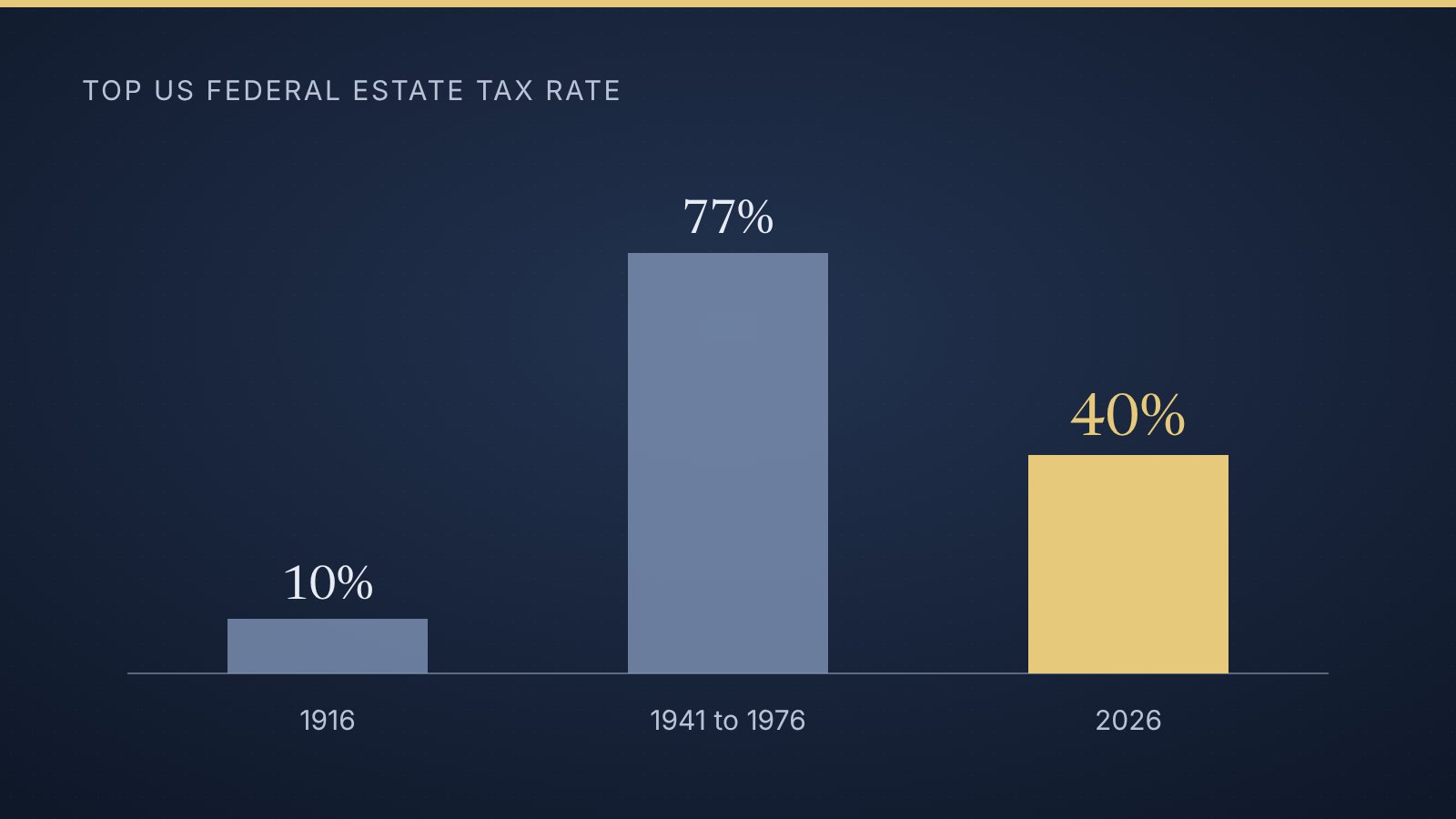
The direct ancestor of today’s estate tax began in 1916 with a top rate of 10%; between 1941 and 1976 the top rate was 77%, CRS says. Abroad, Swiss voters in November 2025 rejected a 50% federal tax on estates and gifts above CHF 50 million by 78.3%. Japan in 1946 went further with a one-time capital levy of up to 90%, imposed under occupation.
The 2027 Figures Are Not Out Yet
As of 20 October 2026 we could not find the 2027 amounts on the IRS website; the IRS says it publishes future amounts in annual revenue procedures. Wolters Kluwer projected on 18 September a 2027 exclusion of $15,480,000 and expects the official figures in late October or early November. Our table of inheritance and estate taxes by country and the US family office guide compare the US rules with other places.
A fair caveat
We have read Kirby’s words only as quoted by other outlets, not the full New York Times interview. The exclusion could still change if Congress acts. Special rules apply to spouses who are not US citizens and to people who are neither US citizens nor residents, and state taxes can apply below the federal threshold.
Five lessons to take away
- An opinion is not a bill. Kirby’s remark has no rate, threshold or sponsor, so it changes nothing today.
- Know which tax is on the table. A wealth tax, an inheritance tax and an estate tax hit different people at different moments.
- The $15 million is per person and indexed. The 2027 figure should be a little higher, but only the IRS can set it.
- Portability needs paperwork. A surviving spouse keeps the unused exclusion only if a Form 706 is filed and the election made.
- Where a tax sits decides how easy it is to leave. A state tax can be left behind by moving to another state, a federal one cannot: Kirby’s own point.
Questions to bring to your advisors
What is our estate worth today if family businesses are valued at market? How much of each person’s lifetime exclusion have we already used on gifts? If one of us died, would the estate file Form 706 to keep the unused exclusion? Which state taxes apply where we live and own property? These are questions to bring to your lawyers and tax advisors, not advice.