Willis Haviland Carrier, the American engineer credited with designing the first modern air-conditioning system, was born on 26 November 1876 on a dairy farm near Angola, New York, so 26 November 2026 is his 150th birthday. Did his invention make him rich? Nobody knows. The official Willis Carrier website says his net worth is not known: no bankbooks or personal financial statements have been found.
Some websites publish figures anyway; we do not. The record answers a better question: how the value of one idea was shared between an inventor, his employer, his partners, a banker and outside shareholders.
What Willis Carrier Invented in 1902
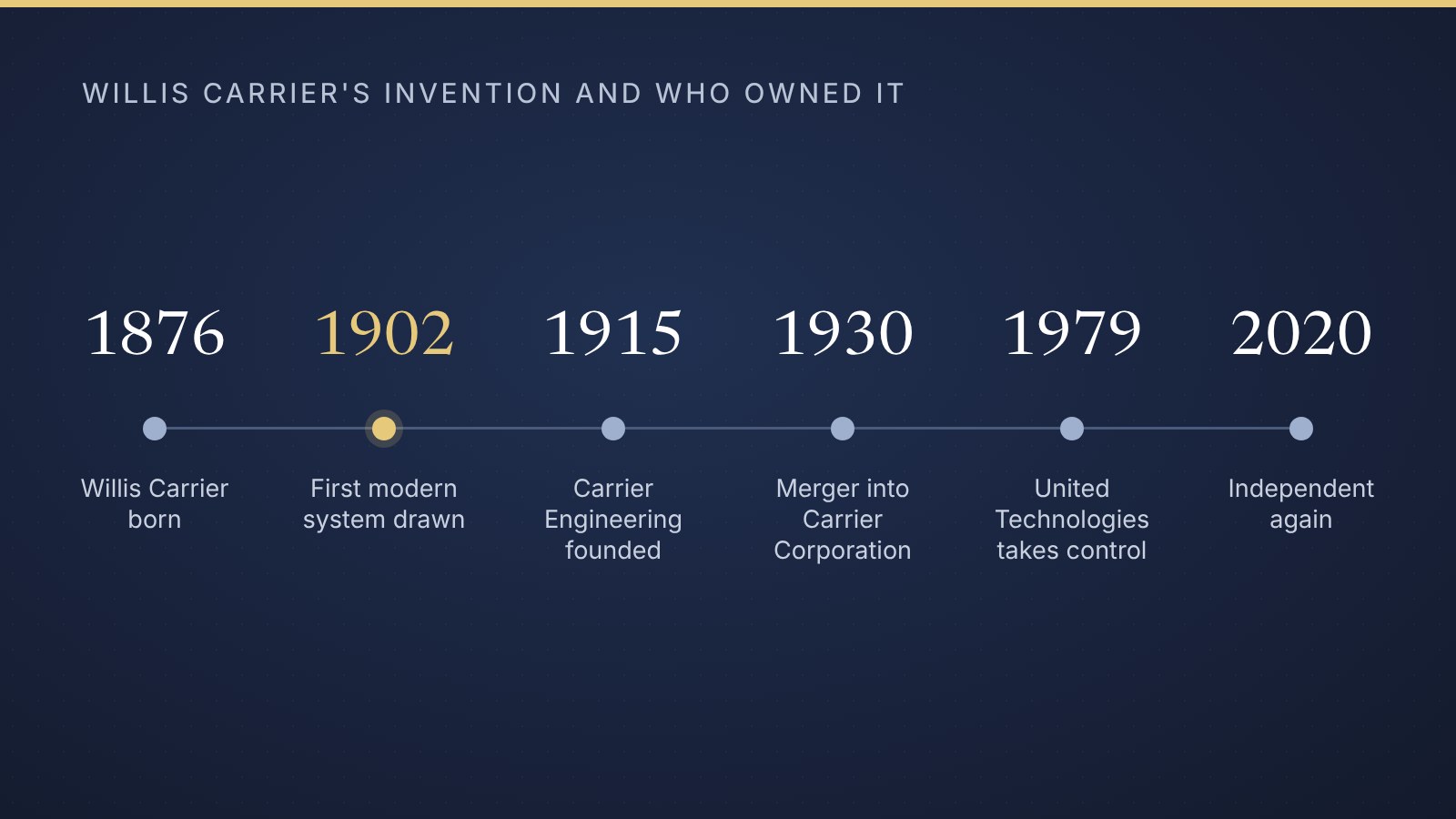
After Cornell University, Carrier joined the Buffalo Forge Company in 1901. On 17 July 1902 he submitted drawings for a system to control humidity at the Brooklyn plant of the Sackett-Wilhelms Lithographing & Publishing Company, where damp summer air made paper grow and shrink. The Carrier company calls this the first modern air-conditioning system. He was granted US patent 808,897 on 2 January 1906 and filed more than 80 patents in all.
The company’s timeline records that in 1906 Buffalo Forge, his employer, sold his apparatus to a cotton mill. An employee’s invention often earns its first revenue for the employer.
Carrier and His Partners: Who Owned the Company
TIME reported in 1998 that Buffalo Forge dropped its engineering department in 1914 and that a year later Carrier left with Irvine Lyle and other young engineers. Carrier Engineering Corporation was formed in New York on 26 June 1915.
TIME, the company and the official site describe Carrier plus six partners; Wikipedia says seven engineers but lists eight names. Wikipedia says they pooled $32,600 of life savings, while the International Directory of Company Histories puts the original capital at $2,500 in stock subscriptions. No source we opened says what share Carrier held. From day one, his idea belonged to a company with several owners.
Merger, Crash and Rescue
On 31 October 1930 Carrier Corporation was incorporated in Delaware, combining Carrier Engineering with heating and refrigeration firms; Wikipedia names Brunswick-Kroeschell and York Heating & Ventilating and says Carrier became chairman. The sources we opened give no terms. In general, a merger paid in shares leaves each founder a smaller slice of a larger business, a kind of dilution that, with share sales, shrank the Disney family’s stake.
The company ran into financial trouble after the 1929 crash, and the official site suggests Carrier’s wealth peaked around then. According to TIME, a Chicago banker, Cloud Wampler, helped bail out the firm during the Depression and later became its chief executive. Wampler recalled Carrier telling him: “We will all work for nothing if we have to.”
Carrier died on 7 October 1950. United Technologies took control in 1979 after a hostile takeover, and Carrier Global Corporation began trading on the New York Stock Exchange as an independent company on 3 April 2020. Like Soichiro Honda, Carrier is remembered through a company, not a family holding.
Who Captures the Value of an Invention
AFP reported in June 2026 that air conditioning has shaped modern life in the Gulf since the 1930s, spreading from oil company compounds and government buildings into homes. Citing a 2025 International Energy Agency report, AFP said air conditioning accounts for around half of peak electricity demand across the Middle East and North Africa. Singapore’s founding prime minister, Lee Kuan Yew, called it a vital invention for Singapore and perhaps one of history’s landmark inventions, because it made development possible in the tropics (remarks republished by the Lowy Institute’s The Interpreter in 2015).
In a 2004 NBER working paper, William Nordhaus estimated that innovators captured only about 2.2% of the total surplus from innovation in the US nonfarm business sector from 1948 to 2001. The NBER summary notes that where knowledge is public, productivity gains are passed on in lower prices. By our reading, Carrier’s story has three layers: the inventor, whose slice was shared from the start; the owners of capital, who rescued and later bought the company; and everyone else, who got cooler offices, homes and cities.
A fair caveat
Carrier’s personal finances are undocumented, so any figure for his fortune is a guess. Sources also disagree on the number of founders and the starting capital, and the electricity figure, for the whole Middle East and North Africa, comes from an IEA report cited by AFP that we did not open.
Five lessons to take away
- An invention is not a fortune. Carrier’s idea changed daily life, yet no one can show what he earned from it.
- Employers often capture the first returns. Buffalo Forge, not Carrier, sold his early apparatus.
- Partners, mergers and rescues divide ownership. Each one can shrink a founder’s slice.
- Timing matters as much as the idea. His wealth probably peaked around 1929, just before the crash.
- Records are part of the legacy. Without bankbooks or statements, heirs cannot show where a family’s wealth came from.
Questions to bring to your advisors
If a family member creates something valuable, who owns it: the person, the employer or the family company? When we take on partners or merge, how do we record each person’s share? Do we keep the records that would show our heirs where our wealth came from? These are questions to bring to your advisors, not advice.