Elon Musk said on SpaceX’s quarterly earnings call on 20 October 2026 that the boards of Tesla and SpaceX had each formed a special committee of independent directors to study a merger, at shareholders’ request. Musk, chief executive and largest individual shareholder of both, said he sits on neither committee: “because I’m a conflicted party, I can’t actually be in the discussions,” TechCrunch and Teslarati reported.
As of 8 November 2026 no terms have been announced, and reports on 4 November said none were agreed. Musk said he likes the idea but warned against treating it as certain. A dominant shareholder on both sides of a deal is the case US courts and lawmakers have built special rules for.
Why Musk Stands on Both Sides
A controlling shareholder can steer a company’s decisions, usually through a large block of votes. The conflict comes when that person owns different slices of buyer and seller, so a price that suits him can short-change minority holders on one side.
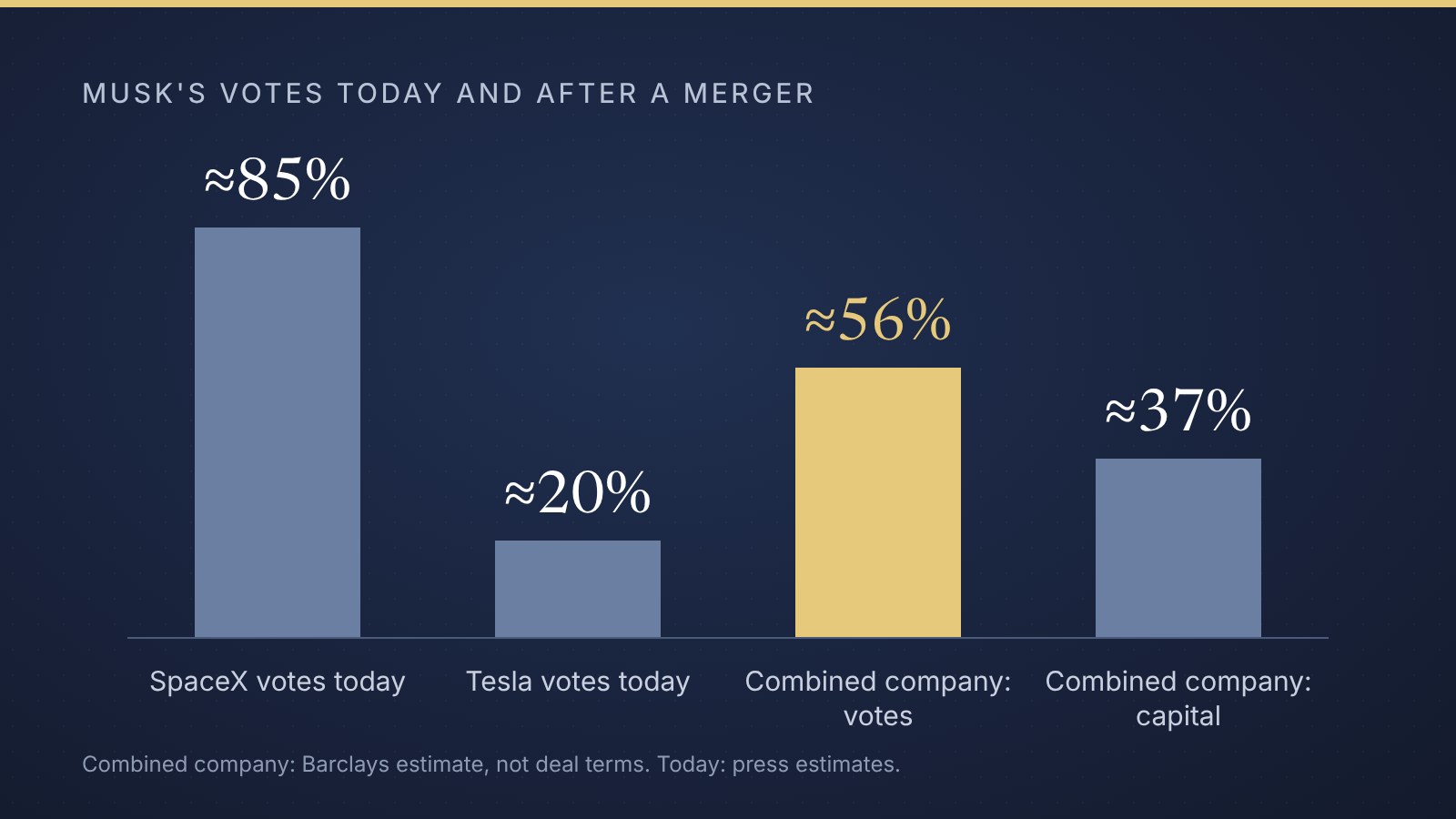
TechCrunch reports that Musk holds more than half of SpaceX’s voting power, a grip its IPO cemented; IBTimes UK, citing reported figures, puts it at about 85%, against about 20% of Tesla’s votes.
In a 14 October note, Barclays analyst Dan Levy called an all-stock purchase of Tesla by SpaceX the most likely structure, according to Bloomberg as reported by Beinsure. Barclays estimated that Musk would then own about 37% of the combined company’s capital but hold about 56% of its votes, because SpaceX’s high-vote shares carry ten times the votes of ordinary ones (IBTimes UK). These are illustrations, not terms. Exor has a similar split, as our Agnelli post shows.
How Special Committees and Minority Votes Work
A special committee is a small group of directors with no stake in the deal, put in charge of a conflicted transaction. At its strongest it hires its own advisers, negotiates the price and can say no.
Tesla’s 19 October proxy statement names seven independent directors under Nasdaq rules, including chair Robyn Denholm, TechCrunch notes. In the reports we read, neither company had named its committee members or advisers. Ira Ehrenpreis, a Tesla director, has also sat on SpaceX’s board since February 2026, the proxy says.
A majority-of-the-minority vote means the deal passes only if most of the shares not owned by the controller vote for it. It gives outside holders a veto.
In Kahn v. M&F Worldwide (14 March 2014), known as MFW, Delaware’s Supreme Court combined the two tools. A controller’s buyout gets the court’s more deferential business judgment review only if it is conditioned from the start on both an independent, empowered committee and an informed, uncoerced majority-of-the-minority vote, Perkins Coie explains. Otherwise “entire fairness” applies, and defendants generally must prove the deal was fair to minority holders.
Tesla, though, has moved its incorporation from Delaware to Texas, Reuters reported. A Texas law signed on 14 May 2025 lets the board of a listed corporation form a committee of independent and disinterested directors to review deals with a controlling shareholder, and ask a court to rule on their independence (Fenwick & West; Gibson Dunn). Neither firm’s summary describes a majority-of-the-minority requirement.
Why the Tesla Vote Is the Hard Part
Musk said a merger would need the support of 50% of all outstanding Tesla shares, not just those voted, a hurdle he called high (TechCrunch, Teslarati). Tesla’s proxy shows why: a 2025 charter amendment failed with about 39.4% of outstanding shares in favour.
By our calculation, if Musk holds about 20% and votes yes, others must add 30% of all shares, or 37.5% of the shares he does not own. A majority-of-the-minority condition would need more than half of those, or over 40% of the total. At SpaceX, where Musk has more than half the votes, approval would be far easier, TechCrunch notes.
Tesla’s annual meeting on 3 December 2026 has no merger item; Teslarati says a merger vote would likely need a separate meeting.
What Families Merging Their Own Companies Can Learn
Families that fold together companies owned in different proportions face the same question on a smaller scale: who negotiates for each side, and who decides? A committee formed before price talks, with its own valuer and the power to refuse, protects relatives with less control, and so does a separate vote for them. In a buyout of a listed company, independent directors may push back, as IDH’s did by recommending rejection of the El Sherbini family’s offer.
What to watch
- Filings naming committee members, advisers or proposed terms.
- Tesla’s 3 December annual meeting, and any separate meeting called for a merger vote.
- Whether any deal is conditioned on a majority-of-the-minority vote at Tesla.
A fair caveat
No deal has been proposed. The ownership figures are press estimates and Barclays’ illustrations, not disclosed terms, and they move with share prices. The legal points are general summaries from law firm notes.
Questions to bring to your advisors
If we merged two family companies that relatives own in different proportions, who would negotiate for each side? Should relatives with smaller stakes get their own vote? How would the deal change who controls the votes, not just who owns the value? These are questions to bring to your advisors, not advice.
