Viessmann Generations Group, the Munich-based company of the Viessmann family, is to become a shareholder of FC Bayern München AG, the company that runs Bayern Munich’s professional football, with a stake of just under 6.7%. The club announced the deal on 22 October 2026. It is the last block of shares the club was willing to open up: the members’ association, FC Bayern München e.V., keeps 70%, and Max Viessmann, the group’s chief executive, is expected to join the supervisory board.
The deal also answers a question many families face: where does the money go after you sell the company that carries your name? The Viessmanns sold their climate business to Carrier Global and are now buying into a scarce asset with a board seat. Neither side disclosed the price.
Who Owns Bayern Munich After the Deal
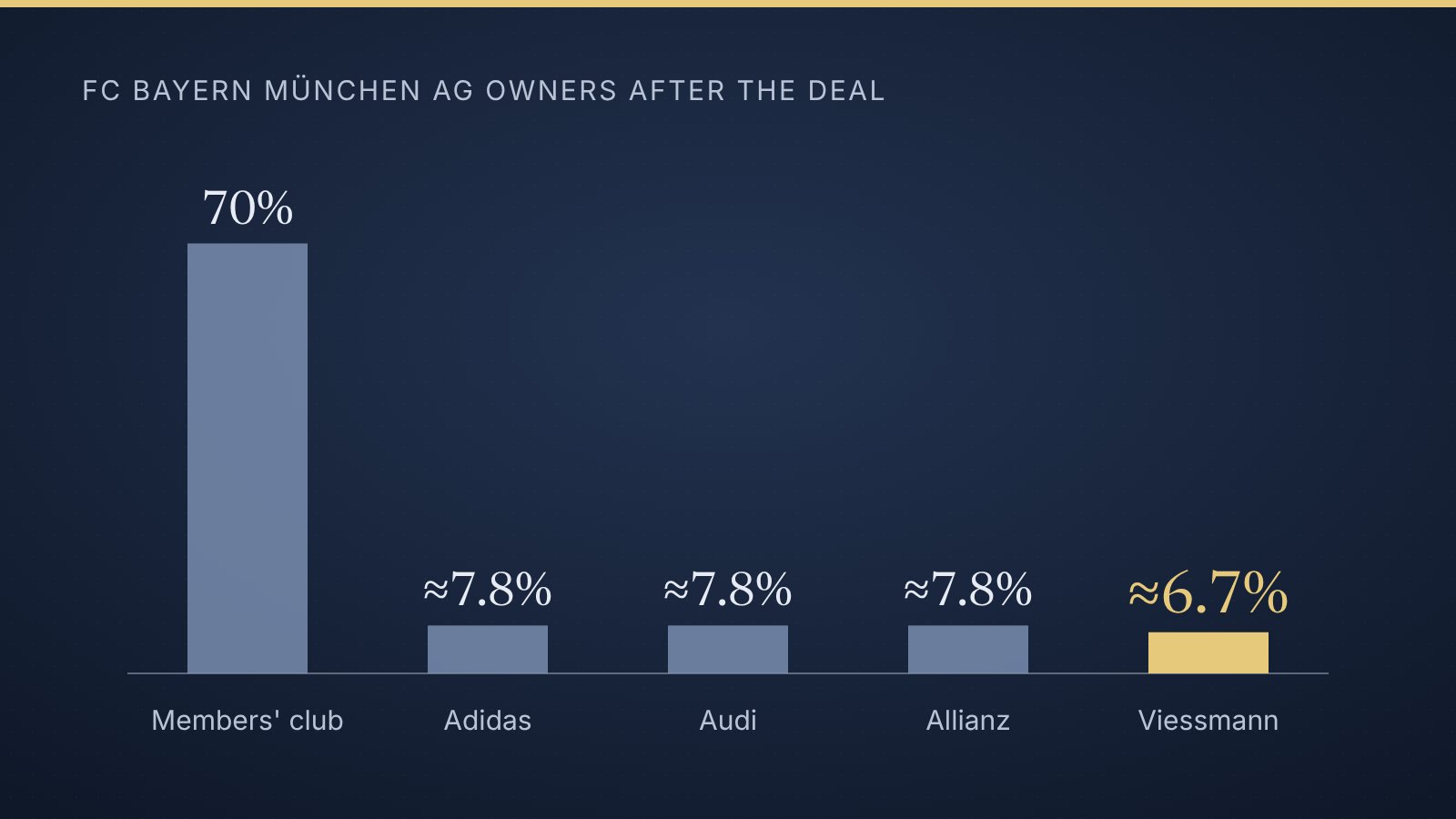
Bayern has two layers. FC Bayern München e.V. is a registered association: it has members, not shareholders. Its articles describe it as the parent company of FC Bayern München AG, the stock corporation that runs the football division. According to the club, the deal changes the AG’s ownership as follows:
- FC Bayern München e.V.: from 75% to 70%.
- Adidas, Audi and Allianz: from 8.33% each to just under 7.8% each.
- Viessmann Generations Group: just under 6.7%.
The four minority shareholders hold 30% between them, and the supervisory board grows from nine to ten members. The deal takes effect once entered in the commercial register.
Why New Shares Instead of a Sale
When the plan surfaced in August, German media, among them tz and Münchner Merkur, described it as a sale of the association’s last 5%, according to ran and Börsen-Zeitung.
The final deal is a capital increase instead. In a sale, an existing owner hands over shares and keeps the cash. In a capital increase, the company issues new shares and keeps the money, and every existing owner’s percentage shrinks in proportion.
That explains the odd number. By our arithmetic, new shares equal to about 7.1% of the old total take the association from 75% to 70%, and they make up about 6.7% of the larger total. Herbert Hainer, the club’s president and chairman of the AG’s supervisory board, said the extra equity gives Bayern “greater flexibility in a time of constant change.” Compare Stephen Ross’s sales of small Dolphins stakes, where the owner sells his own shares and keeps the cash.
What Bayern Shares Have Cost Before
In August, when the plan was still a 5% sale, German media reported a price of about €250 million, and Börsen-Zeitung wrote that this would value the club at €5 billion. That figure was reported for a different structure; no price for the final deal has been confirmed. For scale, Allianz paid €110 million for its 8.33% in 2014, according to the club’s announcement at the time, or about €1.3 billion for the whole company by simple extrapolation.
The 70% Floor and the 50+1 Rule
The 30% limit on outsiders comes from the association’s own articles, as adopted on 12 November 2023. They draw two lines:
- The association’s stake can never fall below half of all shares plus one share.
- A capital increase that takes the association below 70%, or lets one shareholder pass 20%, needs a majority of the executive committee and a three-quarters vote of the members’ general meeting.
Other capital increases need the approval of the executive committee and the advisory board. This deal stops exactly at 70%.
The league adds its own rule. Under “50+1”, the voting majority must stay with the club, so investors cannot simply take over, as Börsen-Zeitung explains. In August 2026 the Federal Cartel Office concluded that the rule is compatible with competition law only if it applies equally to all professional clubs, which puts pressure on the exemptions for the clubs in Leverkusen and Wolfsburg, majority-owned by Bayer and Volkswagen. Bayern’s own limit is stricter, yet Hainer has argued that 50+1 should be scrapped, Börsen-Zeitung reported.
What the Viessmann Family Is Doing With Its Capital
Viessmann was founded in 1917 and is now in its fourth generation. The family sold Viessmann Climate Solutions to Carrier Global for about €12 billion in cash and Carrier shares, in a deal Carrier announced in April 2023 and completed on 2 January 2024. What remains is an industrial group active in more than 40 countries, with about 6,000 employees in its industrial core and revenue of roughly €2 billion a year.
The relationship came first. Viessmann has partnered with Bayern since 2018, and Max Viessmann already sits on the association’s advisory board. The climate partnership has been run with Viessmann Climate Solutions, now part of Carrier, whose chief executive spoke for it at the 2023 extension; the equity goes to the family’s own group. Max Viessmann said the family wants to bring capital and entrepreneurial experience, calling it “a partnership for generations.”
After a large sale, proceeds usually sit in a family holding company or a family office that keeps an operating core, builds a portfolio and sometimes buys an asset for reasons beyond return. A board seat here gives a voice, not control.
A fair caveat
The price and valuation are not public, and the August figures belonged to a different structure. A football club is bought partly for reasons a valuation cannot capture, so it is a poor guide to pricing an ordinary family business.
Five lessons to take away
- Selling the company need not end the family business. Viessmann kept an industrial core and a group to invest from.
- Ask who receives the money. In a capital increase the company gets the cash and every existing owner is diluted.
- Read the statutes before you price the stake. Bayern’s 70% floor set both the size and the limit of this deal.
- A board seat is a voice, not control. At just under 6.7%, Viessmann is the smallest of four minority owners.
- Relationships often come before equity. Eight years of partnership and an advisory board seat preceded the shareholding.
Questions to bring to your advisors
If we sell our main business, how much of the proceeds goes to an operating company, how much to a portfolio, and how much to assets we hold for reasons beyond return? When we buy a minority stake, are we buying existing shares or new ones, and what do the statutes allow later? How would we ever sell? These are questions to bring to your advisors, not advice.
