The Agnelli family, which founded Fiat in Turin in 1899, now holds stakes in several listed companies, not one industrial group. Between 2011 and 2022 Fiat’s businesses were separated into Ferrari, CNH, Iveco Group and the carmaker that is now Stellantis. Exor, the family’s holding company listed in Amsterdam, kept a large stake in each. This post explains how the group was taken apart and rebuilt.
Part 1 covers the founding, and Part 2 how Exor keeps score.
How Fiat Got Out of Its General Motors Put Option
Exor’s own history says the new millennium “began with a business crisis at Fiat”, and that the family changed leadership and added capital. Sergio Marchionne became chief executive in 2004, according to Encyclopaedia Britannica.
When General Motors bought into Fiat in 2000, the deal gave Fiat a put option: the right to sell its loss-making car business to GM, Al Jazeera explained. GM argued the option had become invalid; Fiat said it was enforceable. On 13 February 2005 they settled. GM agreed to pay about $2.0 billion (€1.55 billion, per Al Jazeera) and return its 10% equity interest in Fiat Auto Holdings, GM’s quarterly filing shows. Britannica says Marchionne quickly returned Fiat to profit.
How Fiat Took Over Chrysler and Became FCA
In 2009 Fiat was the buyer. After a new Chrysler company bought the old one’s main assets, Fiat took an initial 20% ownership interest on 10 June 2009, FCA’s 2014 annual report says. It reached 46%, fully diluted, on 24 May 2011. On 21 January 2014 Fiat bought the last 41.5% from the VEBA Trust, which received $3.65 billion, $1.9 billion of it from Chrysler’s own cash, Chrysler’s filing shows.
On 12 October 2014 Fiat S.p.A. merged into what became Fiat Chrysler Automobiles (FCA), listed in New York and Milan the next day. Under its loyalty voting rules, holders of common shares for at least three years could gain special voting shares, which cannot be traded, in effect two votes per share. On 27 February 2015 Exor had about 44.31% of FCA’s voting interest, FCA’s annual report says.
How the Group Was Split Into Listed Companies
A demerger, or spin-off, moves a business into a new company and gives its shares to existing shareholders in proportion to their holdings.
- Fiat Industrial, 2011. With effect from 1 January 2011 Fiat moved part of its assets and liabilities into Fiat Industrial, listed that year, according to FCA’s filing and Exor’s history.
- CNH Industrial, 2013. Fiat Industrial and CNH Global merged into CNH Industrial, listed in New York and Milan, Exor’s history says.
- Ferrari, 2015 to 2016. On 20 October 2015 FCA priced 17,175,000 Ferrari shares at $52 each, raising $893.1 million. On 3 January 2016 it handed the rest to its own shareholders, one Ferrari share per 10 FCA shares, with special voting shares on the same ratio, Ferrari announced. The loyalty votes carried across. Exor became Ferrari’s largest shareholder, with 23%.
- Iveco Group, 2022. The commercial vehicles and powertrain group was demerged from CNH Industrial with effect from 1 January 2022 and began trading on Euronext Milan on 3 January, Iveco Group announced.
What Exor Holds After the Splits
Cars took the other route. FCA’s merger with Groupe PSA created Stellantis at the beginning of 2021, and Exor became its largest shareholder, with 14%, Exor’s history says.
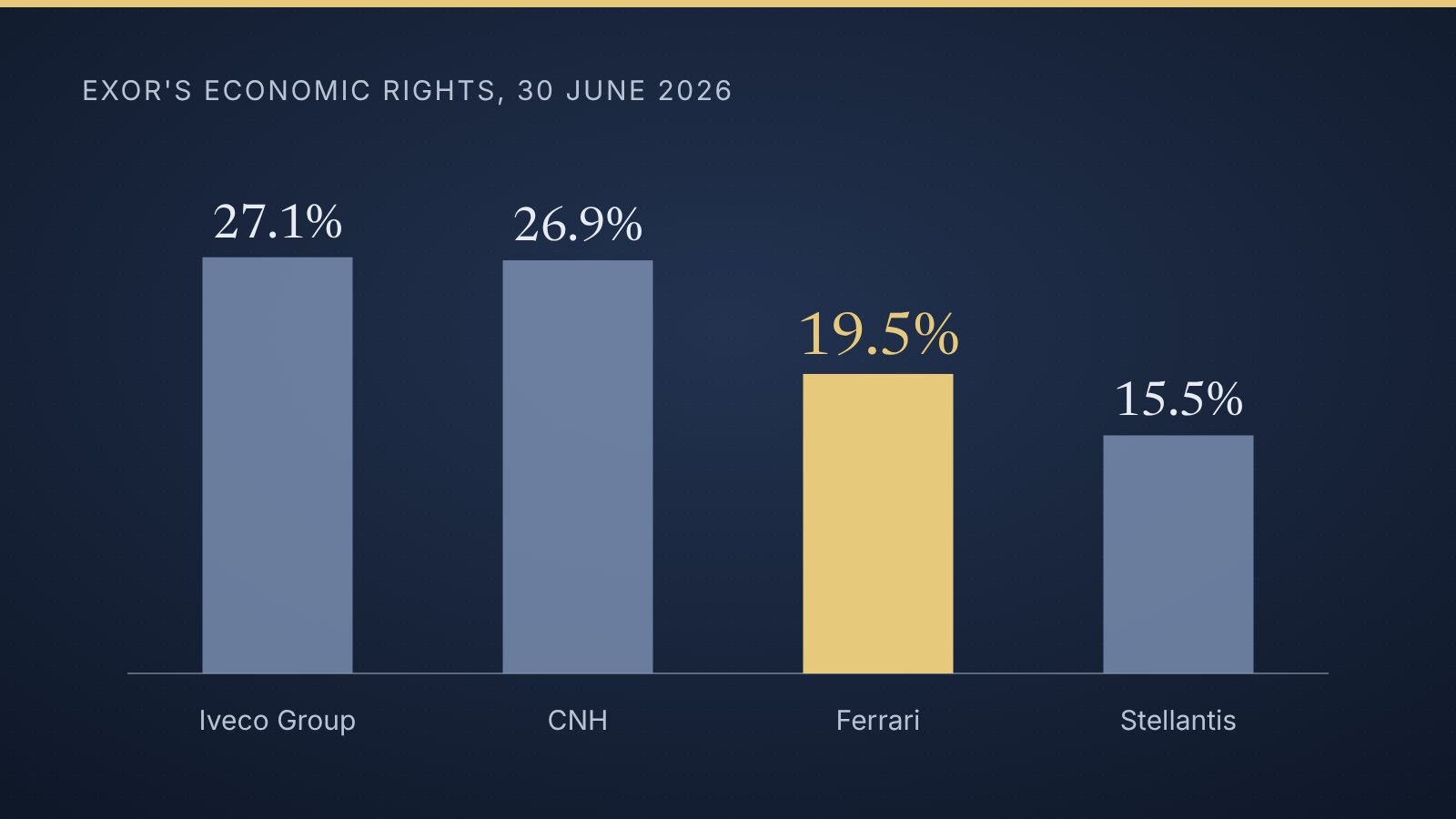
At 30 June 2026 Exor held 19.5% of the economic rights and 32.5% of the votes in Ferrari, 26.9% and 45.6% in CNH, 15.5% and 23.9% in Stellantis, and 27.1% of the economic rights in Iveco Group, its half-year report shows. Part 4 covers what Exor later sold; our Exor profile lists its holdings.
A fair caveat
A split does not prove that value was created; we have not measured returns. Exor’s history gives no figures for the Fiat crisis and does not say whether the 23% Ferrari and 14% Stellantis stakes measure capital or votes. Separate listings also leave concentration: Exor’s Stellantis stake was worth €4,252 million at the end of 2025 and €2,236 million at 30 June 2026, its half-year report shows.
Five lessons to take away
- An exit right has a price, even unused. Fiat’s put option ended in about $2.0 billion from GM, with no sale.
- Buy control in steps. Fiat went from 20% of Chrysler in 2009 to 46% in 2011 and 100% in 2014.
- Give different businesses their own listing. Ferrari, CNH and Iveco Group each got a board and share price.
- A demerger keeps control without new money. Shares go out in proportion, so the family’s stake carries across.
- Write control into the share rules. FCA’s loyalty voting shares, carried over to Ferrari, reward long-term holders with extra votes.
For a family office
A family with several businesses under one roof can ask: which parts would be worth more on their own? Would a demerger keep the family’s stake, and do the share rules reward long-term holders? Which partner contracts, like the GM put option, could force a decision at the wrong time? These are questions to bring to your advisors, not advice.