The Agnelli family helped found Fiat in Turin in 1899 and still controls Exor, the holding company that grew out of its stake. For long stretches, though, the family owned the business without running it.
Part 1 of our five-part series follows Giovanni Agnelli (1866 to 1945), the holding company he set up in 1927, and the hired managers who ran Fiat between generations.
How Giovanni Agnelli Became One of Fiat’s Founders
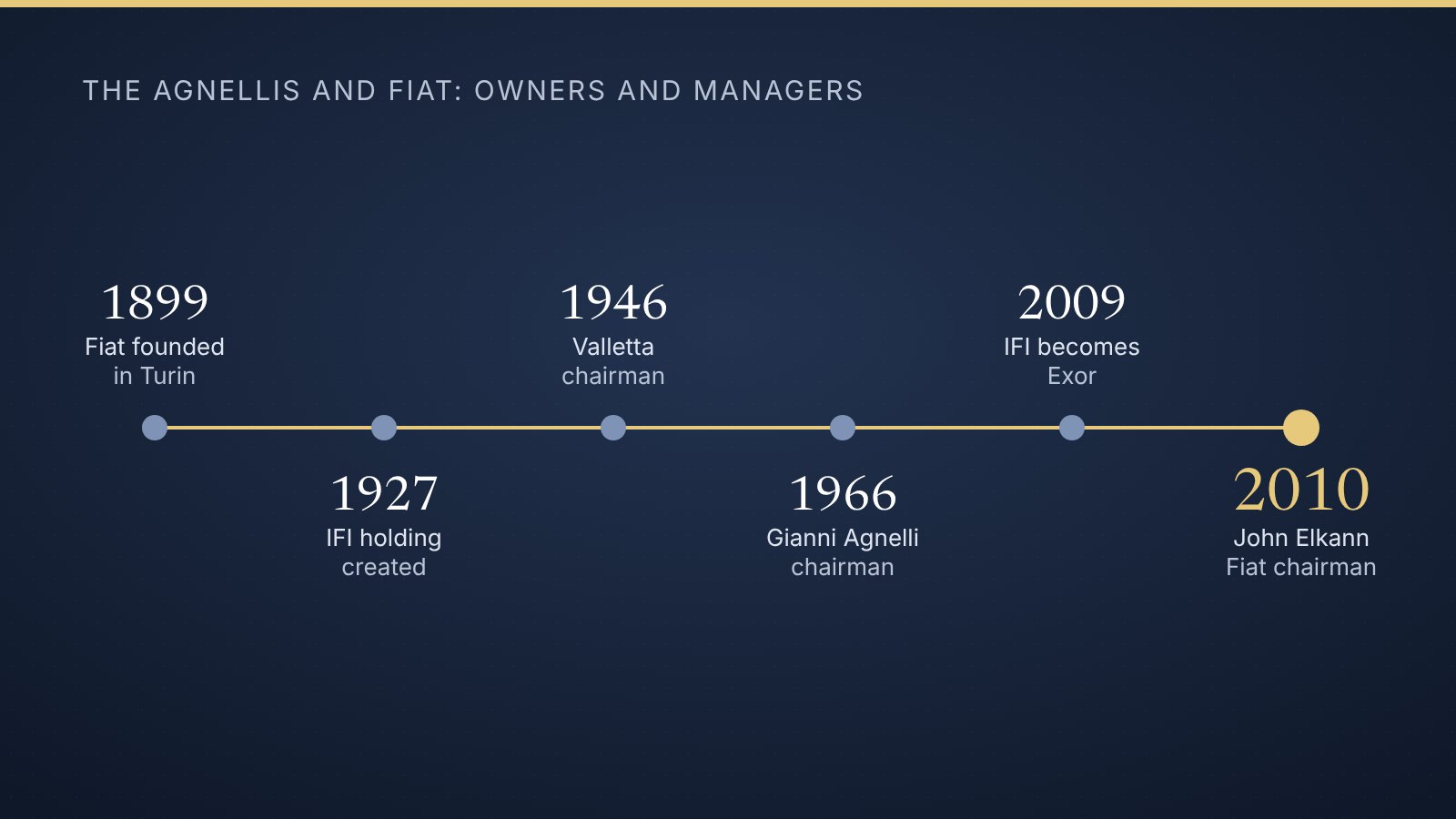
On 11 July 1899 nine founders met before a notary in Turin and formed the Fabbrica Italiana di Automobili Torino, Motor1 Italia recalled at the 125th anniversary. Exor’s history also counts Agnelli and eight others. Motor1 says Agnelli joined late, replacing a partner who withdrew, and became board secretary at once. The capital was 800,000 lire.
Treccani dates his role as managing director from 1905 and his chairmanship from 1920, and Motor1 says he was the majority shareholder from 1906. In 1923 a rooftop test track of about 1 kilometre opened at Fiat’s Lingotto factory in Turin, according to Guinness World Records.
Why Agnelli Created IFI in 1927
In 1927 Agnelli created IFI (Istituto Finanziario Industriale), a holding company to oversee Fiat and his other businesses, according to Exor. A holding company is one whose main job is to own shares in others.
The structure also let outside money in without giving votes away. In early 2008, IFI’s quarterly report shows, the family partnership Giovanni Agnelli e C. held all its ordinary shares, while its preferred shares were listed in Italy. Preferred shares usually rank first for dividends but carry limited votes. In 2009 IFI merged with IFIL, a financial company it had controlled since 1957, and was renamed Exor.
How a Hired Manager Bridged the Gap After 1945
Vittorio Valletta joined Fiat in 1921, became general manager in 1928 and managing director in 1939, according to Franco Amatori’s entry in Treccani’s Dizionario Biografico. At the end of the war, in April 1945, Italy’s Committee of National Liberation removed Agnelli and other top executives from control of Fiat, Britannica says. Agnelli died on 16 December 1945.
His grandson Gianni became vice chairman that year, Treccani notes, but at about 25 did not feel ready, Amatori writes. Valletta returned in March 1946 and became chairman that July. He held less than 1% of the shares; ownership stayed with the family. Management did not: in Britannica’s words, “control did not return to the Agnelli family until 1966.”
Gianni chaired IFI from 1959 and became Fiat’s managing director in 1963, Giuseppe Berta writes in the same dictionary, then succeeded Valletta as chairman in 1966.
How Fiat Passed From Gianni Agnelli to John Elkann
Gianni Agnelli chaired Fiat for 30 years, then resigned in 1996 and became honorary chairman, Treccani says. Managers took the chair again: Cesare Romiti until June 1998, then Paolo Fresco, who came from General Electric, Affaritaliani recalled in 2020. In 2003, the year Gianni Agnelli died, his brother Umberto took the lead during a serious crisis, Treccani notes. Luca Cordero di Montezemolo became chairman in 2004.
The next heir was prepared in the same way. John Elkann, Gianni Agnelli’s grandson, joined Fiat’s board in December 1997 and became vice chairman in 2004, the Associated Press reported. By 2008 he chaired IFI, and in April 2010, aged 34, he replaced Montezemolo as Fiat’s chairman.
Today Elkann is chief executive of Exor N.V., listed in Amsterdam. The family controls it through Giovanni Agnelli B.V., which held 54.94% of Exor’s economic rights and 83.97% of its voting rights at 31 December 2025, Exor says. With outside shareholders, Exor is not a family office; see our Exor profile and Part 5. Part 2 looks at how Exor keeps score.
A fair caveat
Accounts of Fiat’s first years differ. Motor1 also names him managing director at the founding; Treccani dates that role from 1905. Britannica calls him both Fiat’s founder and one of its prime movers. The 1899 figures come from an anniversary article, not the founding deed.
Five lessons to take away
- Ownership and management can be separated. Valletta ran Fiat for two decades with under 1% of the shares.
- Put the stake in a holding company early. IFI held the family’s interests from 1927 until it became Exor in 2009.
- Raise outside money without giving away votes. IFI listed its preferred shares; the family partnership kept all the ordinary ones.
- Let the heir prepare before taking the chair. Gianni Agnelli led IFI and served as managing director before he chaired Fiat.
- Train the next heir over years. John Elkann sat on Fiat’s board for over 12 years before he chaired it.
For a family office
A family that owns a company but has no successor ready faces the Agnellis’ question: who runs the business meanwhile, and on what terms? Who holds the votes while a manager holds the job? Who decides when the heir is ready? Our post on Iba Teigo at Sumitomo shows another hired manager. These are questions to bring to your advisors, not advice.