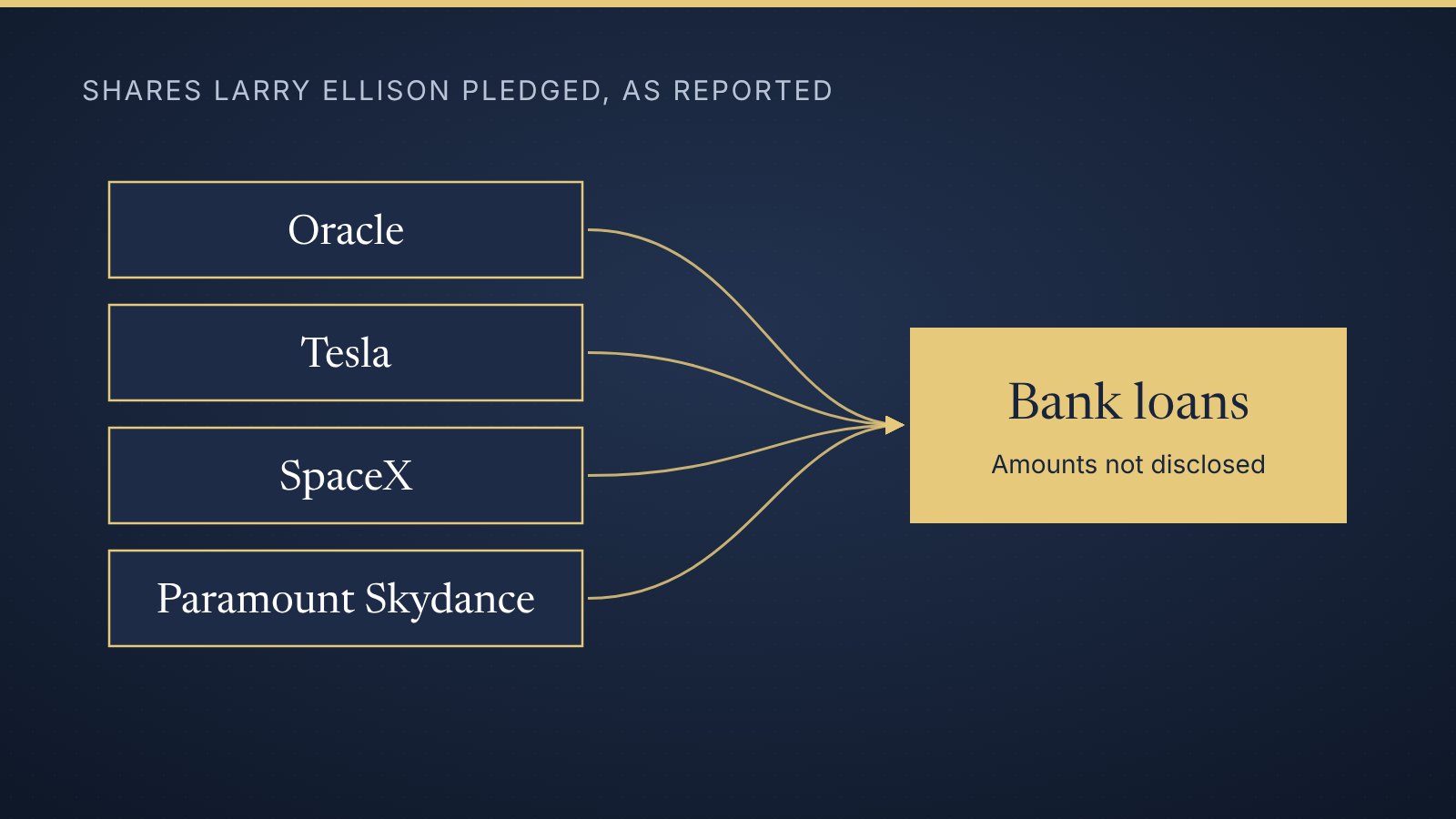
Larry Ellison, the co-founder and largest shareholder of Oracle, pledged shares of Tesla, SpaceX and Paramount Skydance, as well as Oracle, as collateral for bank loans this year, The Wall Street Journal reported on 20 October 2026, according to Quartz and 24/7 Wall St. Citigroup and JPMorgan added the SpaceX and Paramount Skydance shares in the days before 6 October, when his son David’s company completed its purchase of Warner Bros. Discovery, Quartz says. On 22 October Semafor reported that Elon Musk had put roughly $1 billion into Skydance, as the combined company is now called.
The reports do not say how much Ellison borrowed or how much of it went into the Warner deal. They do show how stakes in four companies can become collateral, and what that means for risk. Our earlier post on his 413 million pledged Oracle shares covered the Oracle filing and the deal’s equity; this one explains how loans against shares work.
What the Wall Street Journal Report Adds
Oracle’s proxy statement, our earlier source, covers only Oracle shares. The Journal relied on filings, 24/7 Wall St. says. No loan amounts have been published, and Tesla and SpaceX have not confirmed the pledges, according to 24/7 Wall St.
Did the loans fund the Warner deal? Quartz says only that the pledges came as the takeover neared completion. 24/7 Wall St., summing up the Journal, says the borrowing helped fund it, but notes that Oracle’s filing does not name Warner Bros.; that link comes from the press report. The cable investor John Malone said on 21 October that Ellison had raised “some of the money” using Tesla stock, Variety reported; that is his remark, not a disclosure.
The ties to Musk go back years. Ellison invested in Tesla in 2018 and sat on its board, and put $1 billion into Musk’s 2022 purchase of Twitter, now X, Semafor and TechCrunch note.
Musk’s Reported $1 Billion
Semafor, citing unnamed people familiar with the matter, said Musk’s roughly $1 billion came at about the same time as equity from other investors, including board member Laurene Powell Jobs. It did not say whether he invested personally or through a company, or at what price. Musk and Paramount did not immediately respond to Semafor, nor Skydance to TechCrunch. Malone also predicted a SpaceX investment of $8 billion to $10 billion in Skydance; that is a forecast, not a deal.
Investors who paid the $12 placement price have paper losses: Skydance closed at $7.10, about 41% lower, 24/7 Wall St. reported on 21 October.
How a Loan Against Shares Works
A bank lending against shares lends only part of their market value: the loan-to-value ratio. The gap is the bank’s cushion. If the price falls, the ratio rises. Past an agreed level, the lender makes a margin call: the borrower must add shares or cash, or repay part of the loan. If not, the lender can sell the pledged shares, often into a falling market.
Musk’s Twitter financing shows the numbers. His April 2022 plan included a $12.5 billion margin loan backed by Tesla shares, according to the SEC filing reported by Mediaite. Barron’s, as cited by Benzinga, said the tentative terms set the loan at 20% of the shares’ value, with a margin call if it reached 35%, which a fall of about 43% in Tesla’s price would have caused. Musk did not use the loan in the end; Bloomberg reported that more equity from partners replaced it.
The terms of Ellison’s loans are not public. Oracle says his pledged Oracle shares secure term loans and none sit in margin accounts.
Why Borrow Instead of Selling
As our earlier post explained, a sale can trigger capital gains tax and shrinks a founder’s stake and votes; a loan keeps both but ties the debt to the share price. Pledging several holdings raises more without leaning on one stock, but puts more of the fortune behind debt. Borrowing on top of concentrated holdings is the combination our post on five common mistakes warns about.
Why These Pledges Stand Out
- A newly listed company. SpaceX has traded on Nasdaq only since June, as noted in our post on Musk’s share gift plan. Private company shares have no daily price and are hard to sell, so lenders tend to lend little against them; a new listing gives a price, but a short record.
- The venture as collateral. Pledging Paramount Skydance shares ties the collateral to the deal itself. If the combined company does badly, investment and collateral lose value together.
- Limited visibility. US proxy rules show pledges only by a company’s own directors and top executives, which is why Oracle reports Ellison’s. Other pledges surface through lender filings or the press.
24/7 Wall St. argues that the forced-sale risk sits mainly at Oracle, where Ellison owns about 38%, since the Tesla and SpaceX pledges sit inside far bigger companies. A forced sale moves a price most where the stake is biggest.
A fair caveat
We have not read the Journal’s report; we rely on Quartz and 24/7 Wall St. No loan amounts are public, and nothing we found shows a margin call or a forced sale. Musk’s investment rests on one outlet citing unnamed people, and no company has confirmed it. Ellison is one of the world’s richest people, and Oracle says he can repay his Oracle loans without selling.
Five lessons to take away
- Spreading collateral does not spread the risk away. Every pledged holding is now tied to debt.
- Know your margin-call price. The loan-to-value ratio sets how far a share can fall before the lender calls.
- Pledging the venture you fund doubles the bet. If it falls, the investment and the collateral fall together.
- New or private shares are weaker collateral. Without a long price record, they are harder to value and to sell.
- Disclosure has gaps. Company filings show only insiders’ pledges, so a family needs its own record.
Questions to bring to your advisors
Which of our holdings are pledged, to which lenders, and at what loan-to-value ratio? At what share price would each lender ask for more collateral, and where would that collateral come from? If we back a relative’s venture, are we pledging shares in it too? These are questions to bring to your advisors, not advice.
