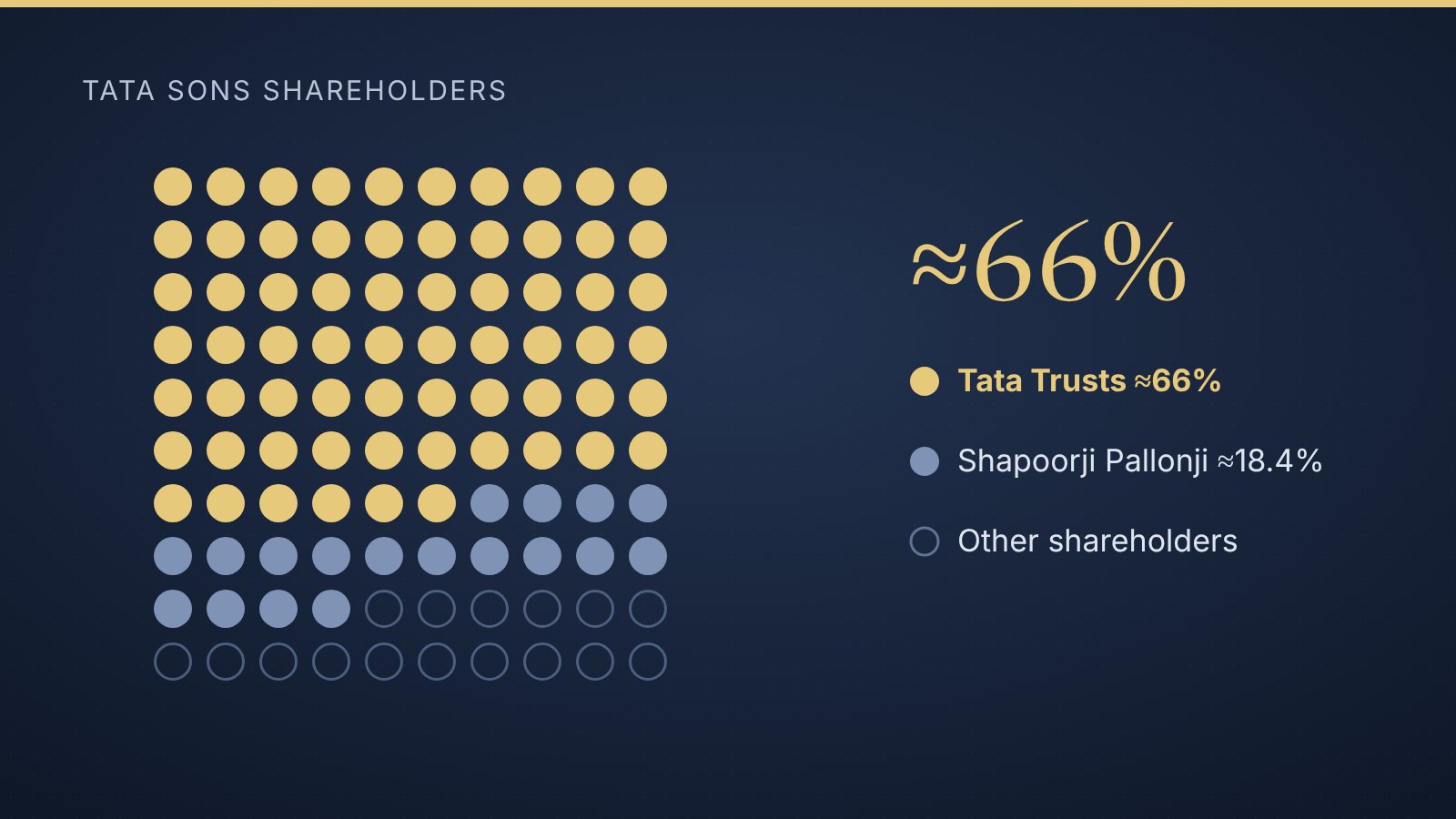
Reserve Bank of India (RBI) Governor Sanjay Malhotra said on 23 October 2026 that core investment companies in its “upper layer” must list. He spoke about the rules in general, but the remark bears on Tata Sons, the Tata group’s unlisted holding company, which the RBI keeps in that layer and which the Tata Trusts, owners of about 66%, want to keep private.
What the RBI Governor Said
At the NDTV World Summit in New Delhi, Malhotra said the RBI does not answer questions about specific entities, according to Business Standard. He added that finance and core investment companies, “like for example Tata Sons and others,” must register because they can use group companies’ balance sheets to repay borrowed funds.
On the upper-layer rules, he said a company with access to funds must register, “and if it is in the upper layer, then it is required to list.” Business Today, citing The Indian Express, carried the same quote.
A core investment company mainly holds shares in its own group. The upper layer is the RBI’s stricter tier for the largest non-bank finance companies, which must list within three years. Tata Sons, placed there in 2022, repaid its debt and asked to deregister; the RBI refused on 11 September 2026, as our earlier post on the Tata Trusts explains.
Where Tata Sons Stands
On 17 September the Tata Sons board agreed to move ahead with a listing and approved a new five-year term for its chairman, N. Chandrasekaran, PTI reported, citing unnamed sources. Noel Tata, who chairs the trusts, opposed both, according to Bloomberg as reported by Business Today. The trusts call the reappointment illegal and want Tata Sons to stay unlisted. The Shapoorji Pallonji group, with about 18.4%, supports a listing.
Shareholders must still approve, at an annual meeting that was adjourned on 18 August for lack of quorum. The quorum needs a representative named jointly by the Sir Dorabji Tata and Sir Ratan Tata trusts, and a May order of Maharashtra’s Charity Commissioner kept the Sir Ratan Tata Trust from meeting to name one, PTI and Business Standard reported.
The trusts’ 28 September proposal to merge two unlisted group companies into Tata Sons, which they say would end its core investment company status, needs board approval and an RBI no-objection. Six Parsi and Zoroastrian bodies, including the Bombay Parsi Punchayet, asked Prime Minister Narendra Modi in a 7 October letter to preserve the trust-led model, Business Today reported, citing the Financial Express.
What a Listing Would Mean for the Trusts
A listing would not by itself end the trusts’ majority: they own about 66%, and no size for a share sale has been announced. It would bring outside shareholders and disclosure duties. As Jio Platforms’ IPO shows, a family-controlled group can sell a minority stake and keep control; here the owners are charities whose trustees disagree.
A fair caveat
The RBI’s letter to Tata Sons has not been published, and the board decision is known through press reports citing unnamed people. We take no side.
What to watch
- Whether the RBI and the Tata Sons board act on the trusts’ merger proposal.
- When Tata Sons can hold its adjourned annual meeting.
- Any court challenge to the chairman’s reappointment.