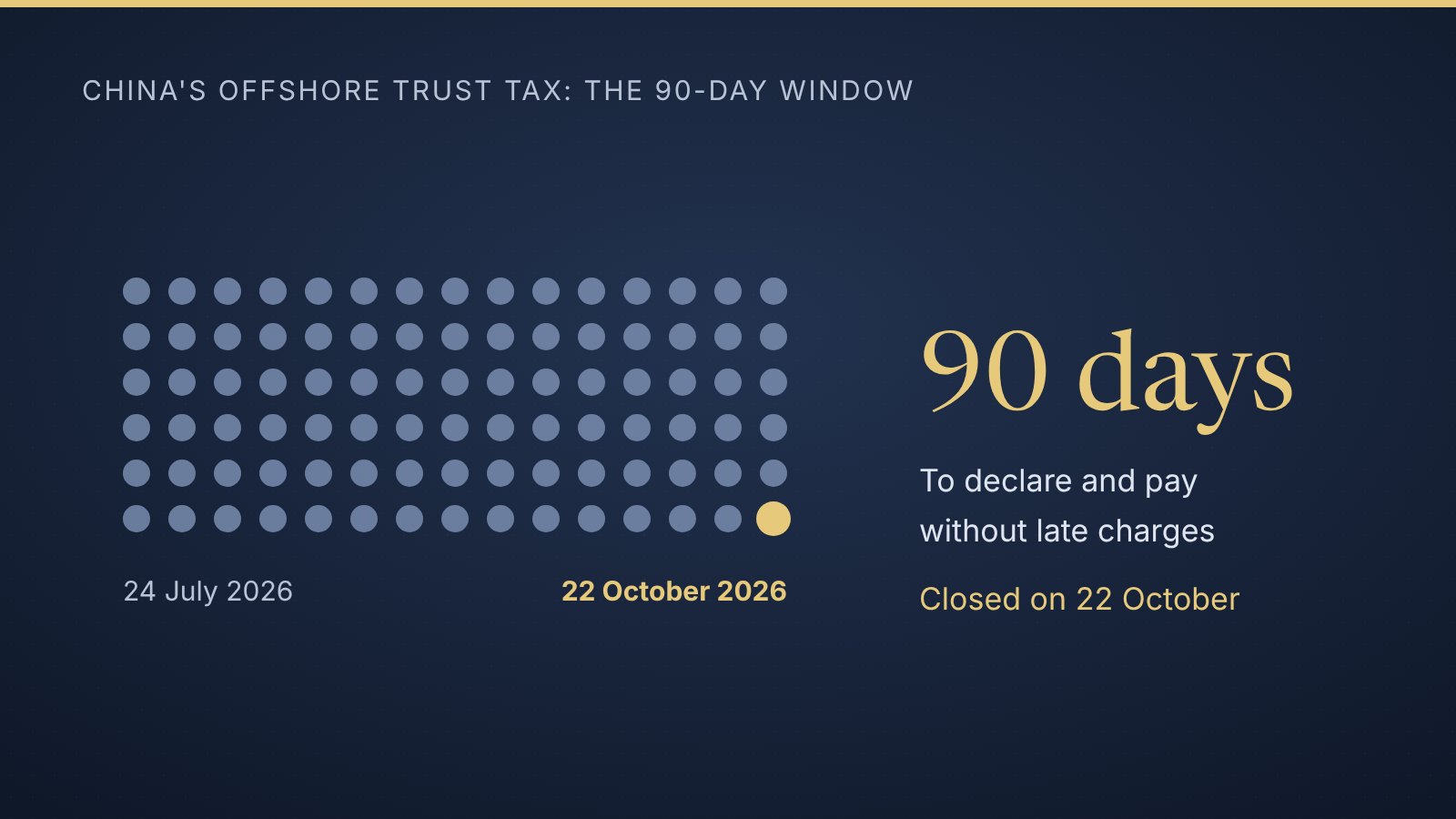
China’s 90-day window to declare and pay back tax on offshore trusts without late-payment charges closed on 22 October 2026. It opened on 24 July, when China set out a flat 20% tax on offshore trusts linked to its residents. Caixin reported on 23 October that the deadline prompted “substantial back-tax payments”, while some taxpayers were holding out over valuations. How many people filed, and how much they paid, is not public. Our explainer covers how the tax works.
What China’s Tax Office Said Before the Deadline
On 19 October, the State Taxation Administration (STA) issued a final reminder to file and pay within the window. Yicai reported that tax paid within the 90 days carries no late-payment charge. After that, charges apply, and where evasion is found, the tax office recovers the tax and charges and adds fines. For large unpaid amounts, it may extend how far back it collects. Caixin reported on 20 October that an STA clarification defines a threshold for that longer look-back and exempts certain employee stock incentive trusts.
What Is Known About Payments, and What Is Not
As of 24 October 2026, we found no official figures on declarations or tax collected. The best-known number measures wealth, not tax. Bloomberg, as reported by Hong Kong’s The Standard, estimated that eight Chinese billionaires among the world’s 500 richest held about $140.2 billion through trusts in places such as the British Virgin Islands and the Cayman Islands, as of 16 October. The largest were NetEase founder William Ding, about $37 billion, and PDD founder Colin Huang, about $29 billion. These are market values, and nothing we read says what, if anything, any of the eight owes.
Where Families Are Finding It Hard
- Valuation. Caixin says some taxpayers dispute valuations and the scope of collection.
- Cash. Some trust holders have sold shares and other assets to pay, according to Caixin. In September, an offshore trust linked to Haidilao’s founding family sold a 4.65% stake for HK$2.75 billion ($351 million), Caixin reported. It said the sale raised questions about a link to the new rules; we found no confirmation.
- Classification. An unnamed person at a Hong Kong-listed mainland company told the South China Morning Post that it won an appeal against a tax demand on a trust for a non-Chinese executive, after arguing it was a stock incentive trust set up in 2021. On paper, a staff share plan and a family trust can look alike.
What to watch
- Whether the STA or local tax offices publish figures on declarations and tax paid.
- How the threshold for a longer look-back is applied in practice.
- Whether more founders’ trusts sell listed shares, and why.
A fair caveat
Caixin’s reports are mostly paywalled, and we read the STA notice through Chinese press reports. We left out circulating details we could not confirm, such as a specific threshold figure. Individual cases rest on unnamed sources.
Questions to bring to your advisors
If a family member funded an offshore trust and did not file by 22 October, what charges now apply? How would the trust’s assets be valued? Is any trust we hold really a staff plan? These are questions to bring to your lawyers and tax advisors, not advice.