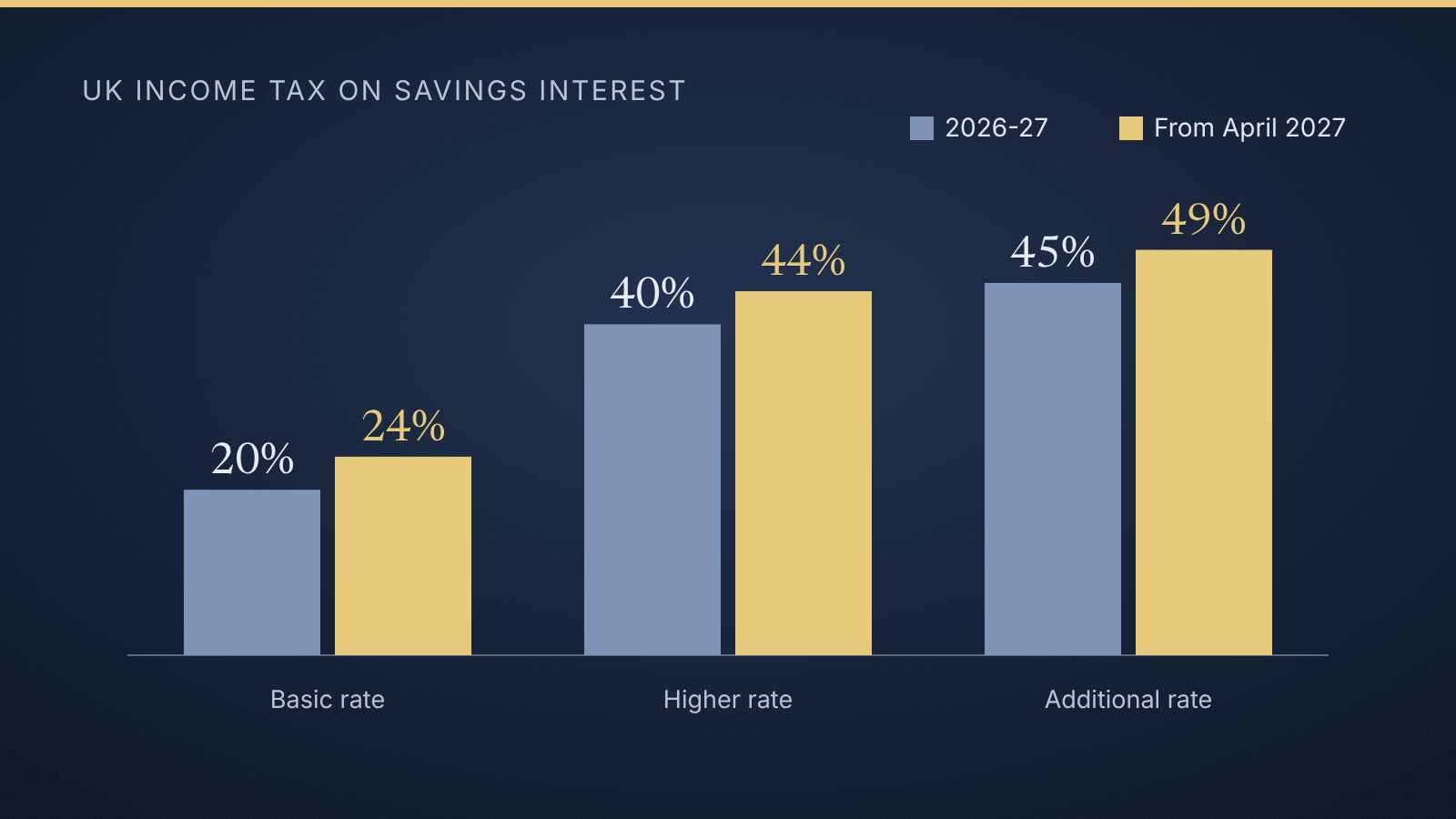
Interest on UK taxpayers’ savings will be taxed at 24%, 44% or 49% from 6 April 2027, depending on the saver’s band, under the Budget of 28 October 2026. The rates are 20%, 40% and 45% now. A higher-rate taxpayer moves from 40% to 44% on interest above the tax-free allowance.
Savings Rates: Now, Planned and New
Budget 2025 had already raised the savings rates by two points for 2027-28, and Finance Act 2026 wrote 22%, 42% and 47% into law. Paragraph 1.1 of HMRC’s Overview of Tax Legislation and Rates (OOTLAR) adds two more points from the same date.
| Band | 2026-27 | Planned before this Budget | From 6 April 2027 |
|---|---|---|---|
| Starting rate (up to £5,000) | 0% | 0% | 0% |
| Basic | 20% | 22% | 24% |
| Higher | 40% | 42% | 44% |
| Additional | 45% | 47% | 49% |
Unlike the new rates on rent, these apply across the whole UK, including Scotland. Tax on wages outside Scotland stays at 20%, 40% and 45%.
The Allowances That Stay
Three reliefs stay unchanged for 2027-28, according to HMRC’s rates annex and OOTLAR:
- Personal savings allowance: the first £1,000 of interest is tax-free for basic-rate taxpayers and £500 for higher-rate taxpayers.
- Starting rate for savings: up to £5,000 of interest at 0% for those who qualify; Finance Act 2026 freezes the limit to 2030-31.
- Cash ISA: the £20,000 yearly limit stays (OOTLAR paragraph 2.5), reversing a planned cut.
The Treasury says a basic-rate taxpayer would need more than £25,000 of savings outside an ISA before paying tax. That matches the £1,000 allowance at 4% interest (our calculation).
On £10,000 of interest for a higher-rate taxpayer, £9,500 is taxable after the £500 allowance: £3,800 today, £3,990 under last year’s plan, £4,180 from April 2027. From April 2027 interest also counts last: the personal allowance and similar reliefs go against other income first, HMRC’s 2025 policy paper says.
Family Companies and Trusts
The new rates fall on individuals, with separate rates for trusts. A family investment company, a private company holding a family’s investments, usually pays its shareholders dividends, and the Budget kept dividend rates at 10.75%, 35.75% and 39.35% for 2027-28. Our guide to holding structures explains how such companies and trusts work.
HMRC’s rates annex sets the trust rate on accumulated and discretionary savings income at 49% for 2027-28, against 45% today. See our Budget overview, new rates on rent and UK guide.
What to watch
- Deposit interest rates, which decide how much savings the £1,000 allowance covers.
- Parliament’s debate on the rates in the Finance Bill 2026-27.
- The secondary legislation keeping the cash ISA limit at £20,000, due in November 2026.
A fair caveat
The rates are not yet law. Our example ignores other income, and the Treasury’s £25,000 figure depends on the interest rate assumed.
Questions to bring to your advisors
How much of our family’s income is interest, and in whose names do the deposits sit? Would any of it be taxed differently held another way? These are questions to bring to your lawyers and tax advisors, not advice.