Bidding for the initial public offering (IPO) of Jio Platforms, the telecom and digital arm of Reliance Industries, closed at 5 pm India time on 23 October 2026 with bids for 22.19 times the shares on offer. That is the cumulative NSE data up to 7 pm, as reported by Upstox; Business Standard and HDFC Sky reported the same figure. Investors bid for about 438.3 crore shares (a crore is 10 million) against 19.75 crore on offer.
For the Ambani family, the multiple matters less than it seems. The issue size is fixed and every share is new, so demand changes who gets shares, not how much Jio raises or Reliance keeps. Our earlier post on the Jio IPO explains how the family keeps control.
How Demand for Jio’s IPO Built Up
- 21 October: fully subscribed within two hours of opening, according to Reuters.
- End of day 2: 5.57 times, according to Inc42 and Angel One, citing exchange data.
- Later on 23 October, before the close: more than 13 times overall, according to Reuters.
- End of bidding: 22.19 times overall.
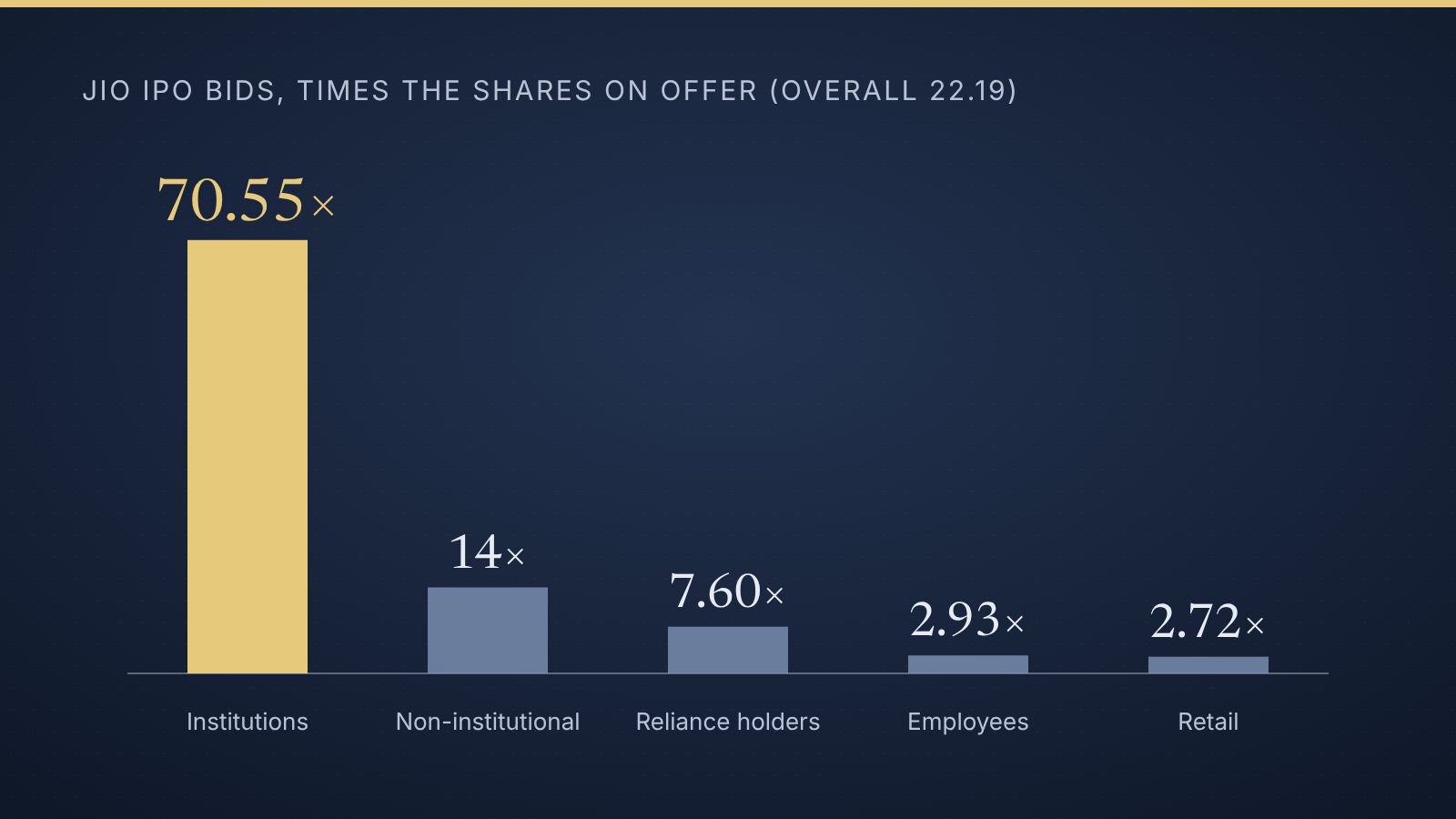
By category, institutions bid for 70.55 times their portion, non-institutional investors (wealthy individuals and companies) 14 times, retail investors 2.72 times, employees 2.93 times and eligible Reliance shareholders 7.60 times, Business Standard reported. The public offer drew bids worth more than ₹4.9 trillion, not counting the anchor book, and applications approached 13.9 million, the paper added.
The multiples are measured against 19.75 crore shares, not 27 crore, because about 7.25 crore had already gone to anchor investors, by our arithmetic.
What Oversubscription Does Not Change
Jio sold a fixed 27 crore new shares. It set the issue price at ₹1,119, the top of the ₹1,065 to ₹1,119 band, Business Today and HDFC Sky reported on 26 October, so the issue raised about ₹30,213 crore, or about ₹30,188 crore after the discount for employees, whether the book is covered twice or twenty times. Reliance sells nothing, so its stake shrinks only through dilution, to about 64.5% by our earlier arithmetic. By contrast, in Mynt’s GCash IPO most of the money went to selling shareholders, and Airtel Money’s London float raised nothing for the company.
What Demand Does Change
Demand changes allocation. Taken together, institutions could receive only about 1.4% of the shares they bid for, non-institutional investors about 7%, retail investors a little over a third and eligible shareholders about 13%, by our arithmetic from the exchange figures. The basis of allotment set how each portion was shared out.
The shareholders’ quota, up to ₹2,500 crore for eligible Reliance shareholders, drew 7.60 times. It shows how a parent company can give its own investors a reserved slice of a subsidiary’s listing.
How the Shares Were Allotted
The basis of allotment, which sets how the shares in each category are shared out, was due on 26 October and was completed that night: HDFC Sky dates the allotment 26 October, while Upstox reported it finalised just after midnight, on 27 October. The registrar is KFin Technologies. Shares were due to be credited to successful applicants’ demat (electronic share) accounts, and refunds processed for the rest, on 27 October, according to Upstox and HDFC Sky.
The minimum bid was one lot of 12 shares, or ₹13,428 at the issue price. Under India’s IPO rules, each retail applicant receives at least one lot if there are enough shares, and a lottery decides who gets one if there are not. The retail portion of about 8.5 crore shares covers about 7.09 million lots, by our arithmetic. The registrar’s final figures, such as valid applications by category and the share of retail applicants who received a lot, were not in any report we could read by the afternoon of 28 October, so we do not give them.
How Jio Shares Traded on Day One
Jio Platforms shares began trading on the NSE and BSE on 28 October 2026 and opened at ₹1,358 on both exchanges, according to the Press Trust of India (PTI) and IPO Ji. That is ₹239 a share, or 21.36%, above the ₹1,119 issue price, by our calculation, and ₹2,868 on a 12-share lot. In morning trade the price reached ₹1,375 on the BSE and ₹1,374.50 on the NSE, PTI reported. We could not confirm the closing prices from the reports we were able to read.
PTI put Jio’s market value at about ₹12.57 trillion in morning trade, which made it India’s second most valuable listed company, behind only its parent, Reliance Industries. At that value, Reliance’s stake of about 64.5% would be worth roughly ₹8 trillion, by our arithmetic. For the family, this is what a listing changes: a holding once valued only in private deals now has a daily market price, set by trading in a small slice of the company.
A fair caveat
Upstox cites cumulative NSE data as of 7 pm on 23 October, and HDFC Sky gives the same 22.19 times from BSE bid details for that day. Some IPO data sites, such as IPO Ji and Chittorgarh, showed a slightly lower total of about 21.3 times. The registrar’s basis of allotment counts only valid bids, so its final figures may differ from these, and we could not find them in the reports we read. The listing figures come from reports published by midday on 28 October, and one strong opening says nothing certain about how the shares will trade later.
What to watch
- How the price holds up after the first day, with only about 2.9% of the company sold in the IPO.
- The end of the 30-day lock-up on half of the anchor investors’ shares, in late November by our count.
- How Jio’s market value compares with Reliance’s own, now that investors can price the two separately.