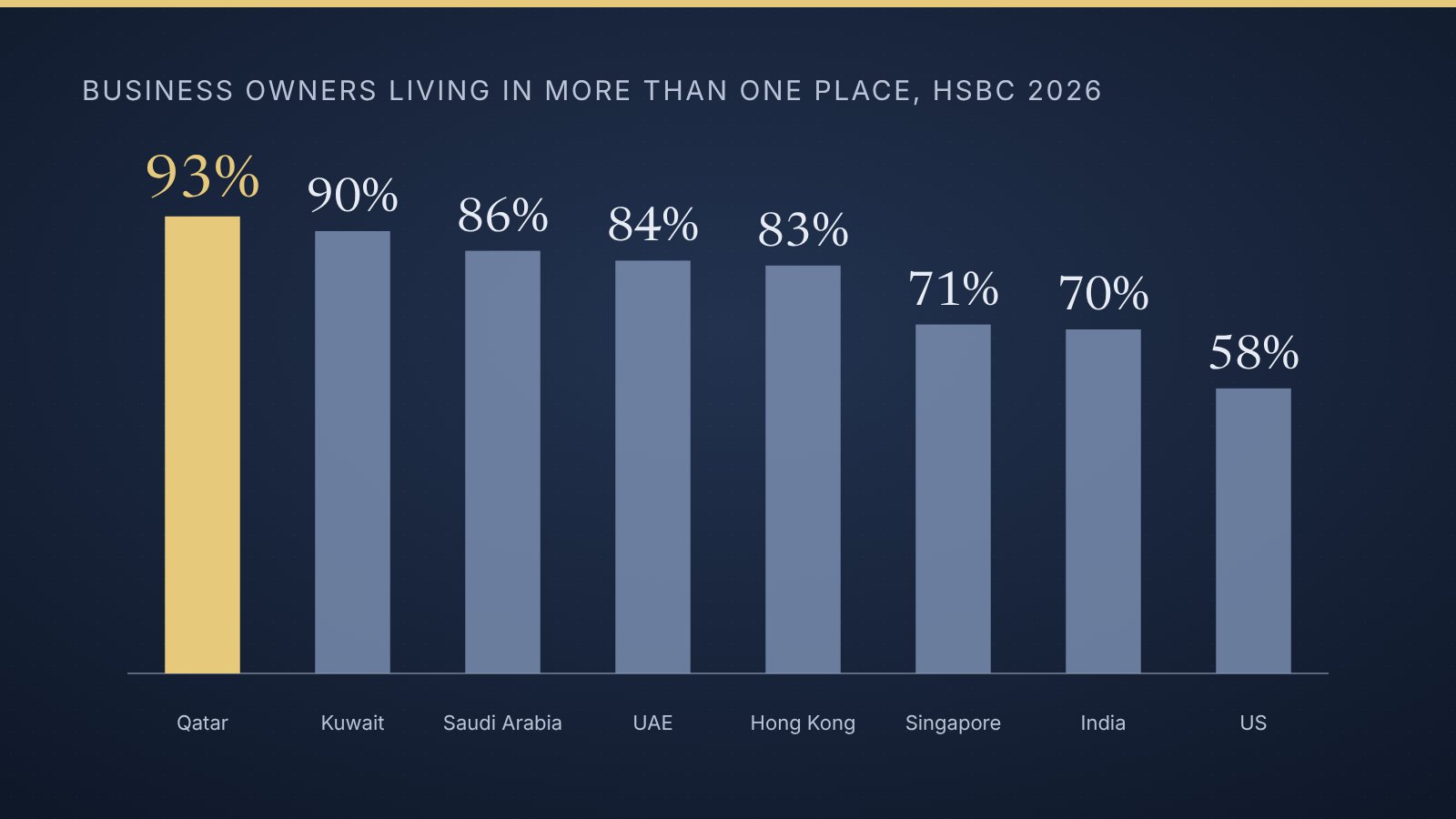
72% of wealthy business owners live part of the year in more than one country or territory, and 70% are considering new residencies, according to HSBC Private Bank’s Global Entrepreneurial Wealth Report 2026. The report came out in late September (Ipsos dates its page 25 September), so this is not fresh news. The useful detail is the split by market, which shows Gulf business owners far ahead.
Who Was Surveyed
Ipsos UK ran a 20-minute online survey for HSBC between 1 April and 15 May 2026. It reached 3,288 business owners in 17 markets; residence figures cover the 3,085 current owners. To qualify, people needed at least $2m of investable assets or $20m of net worth, and a main residence, meaning more than six months a year, in one of the markets.
What “Multi-Resident” Means Here
The survey asked about other countries or territories that owners “personally reside in for some or part of the year.” So it measures where people actually live, not residence permits, passports or tax residence. These are different things: a second home does not by itself change where you pay tax, and a second citizenship does not require you to live anywhere. Our post on the UK billionaire exodus claim explains how residence, assets and tax interact.
The Gulf Leads
| Market | Live in more than one place |
|---|---|
| Qatar | 93% |
| Kuwait | 90% |
| Saudi Arabia | 86% |
| UAE | 84%, per Caproasia |
| Hong Kong | 83% |
| Singapore | 71% |
| India | 70% |
| United States | 58% |
| All 17 markets | 72% |
Singapore is the top destination: 9% of all owners plan a residency there, ahead of Japan at 7%. Among Indian owners, 74% plan to relocate or add a residency and 14% name Singapore, UNI India reported. See our guides to Singapore and DIFC in Dubai.
The most widely held assets are gold (43%), cash (37%) and real estate funds (36%).
What It Means for a Family
Every extra home is another set of rules: residence tests, property law and, in some places, inheritance rules that apply to assets located there. A family spread across three countries needs its wills, holding companies and bank accounts to fit together, and someone, often a family office, to keep the map current.
A fair caveat
This is a survey of owners who chose to take part, defined by HSBC’s thresholds. Market samples are smaller than the total, and the global average is weighted while market figures are not. In Gulf markets many respondents may be expatriates who keep a home in their country of origin; the report does not say.
What to watch
- Whether HSBC publishes where Gulf owners plan to add a residence.
- Changes to residence routes in Singapore and the UAE, tracked in our residence table.
- The 2027 edition: the 2025 report covered fewer markets, so year-on-year comparisons need care.
Questions to bring to your advisors
If family members live in several countries, which one decides where each of us is taxed, and do our wills and holdings still fit? These are questions to bring to your advisors, not advice.