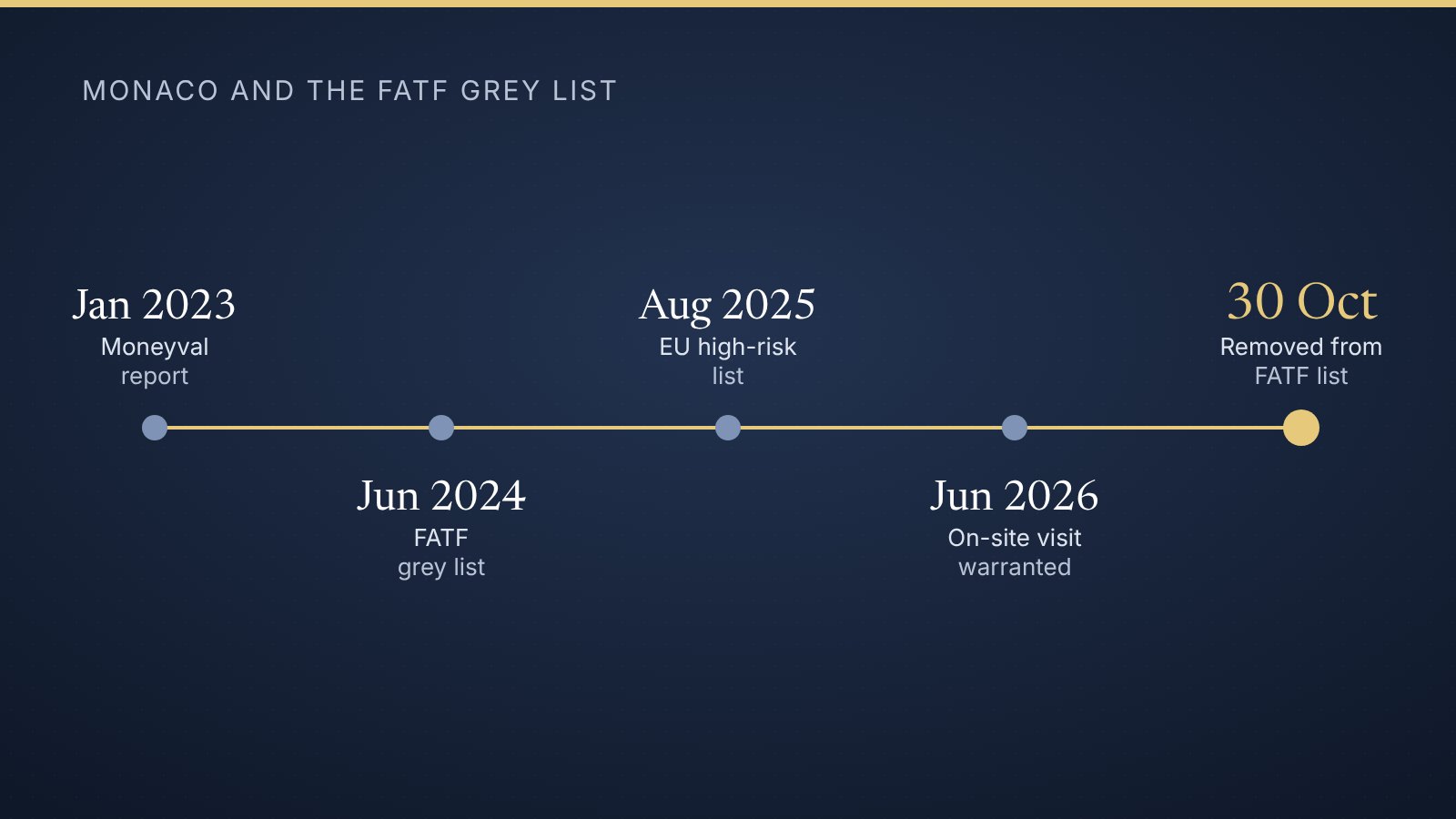
Monaco is off the Financial Action Task Force’s grey list. The FATF, the global standard-setter against money laundering, removed it on 30 October 2026, at the end of its plenary in Paris, together with Bulgaria, Côte d’Ivoire and the Democratic Republic of the Congo, Monaco Life and AML UAE reported. Monaco had been on the list since June 2024.
Bloomberg had reported the expected removal on 16 September, citing unnamed sources. For families with assets in Monaco, the decision matters, but a separate European Union list carries more practical weight, and it did not change on 30 October.
What the FATF grey list is
The FATF’s grey list, formally “jurisdictions under increased monitoring”, holds countries that have agreed an action plan to fix strategic deficiencies on a set timetable.
It is not the blacklist, the short list of countries such as Iran and North Korea against which the FATF calls for action. For the grey list, the FATF says it “does not call for the application of enhanced due diligence measures” and asks for a risk-based approach. In practice, a listing still draws extra scrutiny from banks.
Why Monaco was grey-listed in June 2024
The listing grew out of an evaluation by Moneyval, the Council of Europe’s anti-money-laundering body, published in January 2023. On 28 June 2024, at a plenary in Singapore, the FATF added Monaco to the list. “Monaco needs to address strategic deficiencies,” said Raja Kumar, then FATF president, according to AFP.
The problem was results more than laws. In a December 2024 follow-up, Moneyval re-rated Monaco on 15 of the 40 FATF Recommendations, and the government said Monaco was now compliant or largely compliant with 39 of them. The six-point action plan targets effectiveness: understanding the risks linked to money laundering and income tax fraud committed abroad, seizing more criminal assets at home and abroad, stronger sanctions (including for beneficial-ownership breaches), a fully staffed financial intelligence unit, and more resources for judges and prosecutors. In December 2024, the government said removal could come in mid-2026.
A beneficial owner is the person who ultimately owns or controls a company; we explained the idea in our post on Switzerland’s beneficial-ownership register.
How a country leaves the grey list
There are three steps: the FATF finds the action plan substantially complete, an on-site visit checks that the reforms work in practice, and the plenary, deciding by consensus, ends the monitoring.
Monaco passed the first step on 19 June 2026, when the FATF made an initial determination that it had substantially completed its action plan and said an on-site assessment was warranted, to verify that the reforms had begun and were being sustained. Bulgaria, Côte d’Ivoire and the Democratic Republic of the Congo reached the same stage. At that plenary, Algeria and Namibia left the list after what the FATF called “successful on-site visits”.
What happened on 30 October
The FATF’s October meetings ran in Paris from 26 to 30 October 2026, with the plenary on 28 to 30 October. On the last day, FATF President Giles Thomson announced that Monaco, Bulgaria, Côte d’Ivoire and the Democratic Republic of the Congo were leaving the list: “We must acknowledge the significant strides made by these jurisdictions,” Monaco Life quoted him as saying. AML UAE reported that the four had completed their action plans and that on-site visits had confirmed the reforms were being implemented.
Monaco’s Minister of State, Christophe Mirmand, said the government did not see the decision as “a finish line”, Monaco Life reported. The government said the committee coordinating its national anti-money-laundering strategy would stay in place, with a review of laws and rules and a third national risk assessment under way.
The EU high-risk list is a separate list
The European Commission keeps its own list of high-risk third countries. It added Monaco on 10 June 2025, in Delegated Regulation (EU) 2025/1184, which took effect on 5 August 2025 after the European Parliament and the Council raised no objection.
This list has legal force. EU banks and other firms covered by anti-money-laundering rules must apply enhanced due diligence to relationships and transactions involving a listed country. As law firm Bird & Bird summarises it, that means more information on the customer, the beneficial owner, the source of funds and wealth and the reasons for transactions, senior management approval, and closer monitoring.
A decision in Paris does not change this list by itself: the Commission must adopt a new delegated regulation. The lag can be long. The FATF removed Senegal in October 2024 and the Philippines in February 2025, but both left the EU list only on 5 August 2025.
What it means for a family with Monaco links
Inside Monaco, supervision has tightened regardless of the listing. In April 2026, the AMSF, Monaco’s financial security authority, fined UBS (Monaco) €6 million after a 2024 inspection, according to Bloomberg and the Swiss news agency Keystone-SDA. The failings included weak source-of-wealth checks and gaps in identifying who controls complex structures. UBS said it was reviewing the decision. A family holding assets through trusts, foundations or holding companies should expect questions about the whole chain.
Outside Monaco, the EU list matters more for now: until the Commission acts, EU banks and firms must keep applying enhanced checks to Monaco links. Neither list changes tax. Monaco’s tax and residence rules, set out in our Monaco family office guide, stay as they are.
A fair caveat
We report the decision from Monaco Life and AML UAE; the FATF’s own October statement had not loaded for us when we updated this post on 30 October. The removal does not end the EU requirements at once, and some banks may keep extra checks for a while. We could not confirm the date or detailed findings of the on-site visit.
Five lessons to take away
- Check the exact status. A press report is not an FATF decision.
- Two lists, two timetables. The FATF and EU lists are separate, and the EU has followed months later.
- The FATF list alone does not require enhanced checks. The EU list does, for EU banks and firms.
- Supervision is the lasting change. Scrutiny of source of wealth and ownership chains will not end with a delisting.
- Keep the paper trail ready. Clear ownership and source-of-wealth records make any review faster.
Questions to bring to your advisors
Which of our banks and service providers are in the EU, and what extra checks do they apply to our Monaco links? Can we show the full ownership chain of every structure and the source of wealth behind it? Now that the FATF has removed Monaco, when will our providers change their treatment? These are questions to bring to your lawyers and tax advisors, not advice.