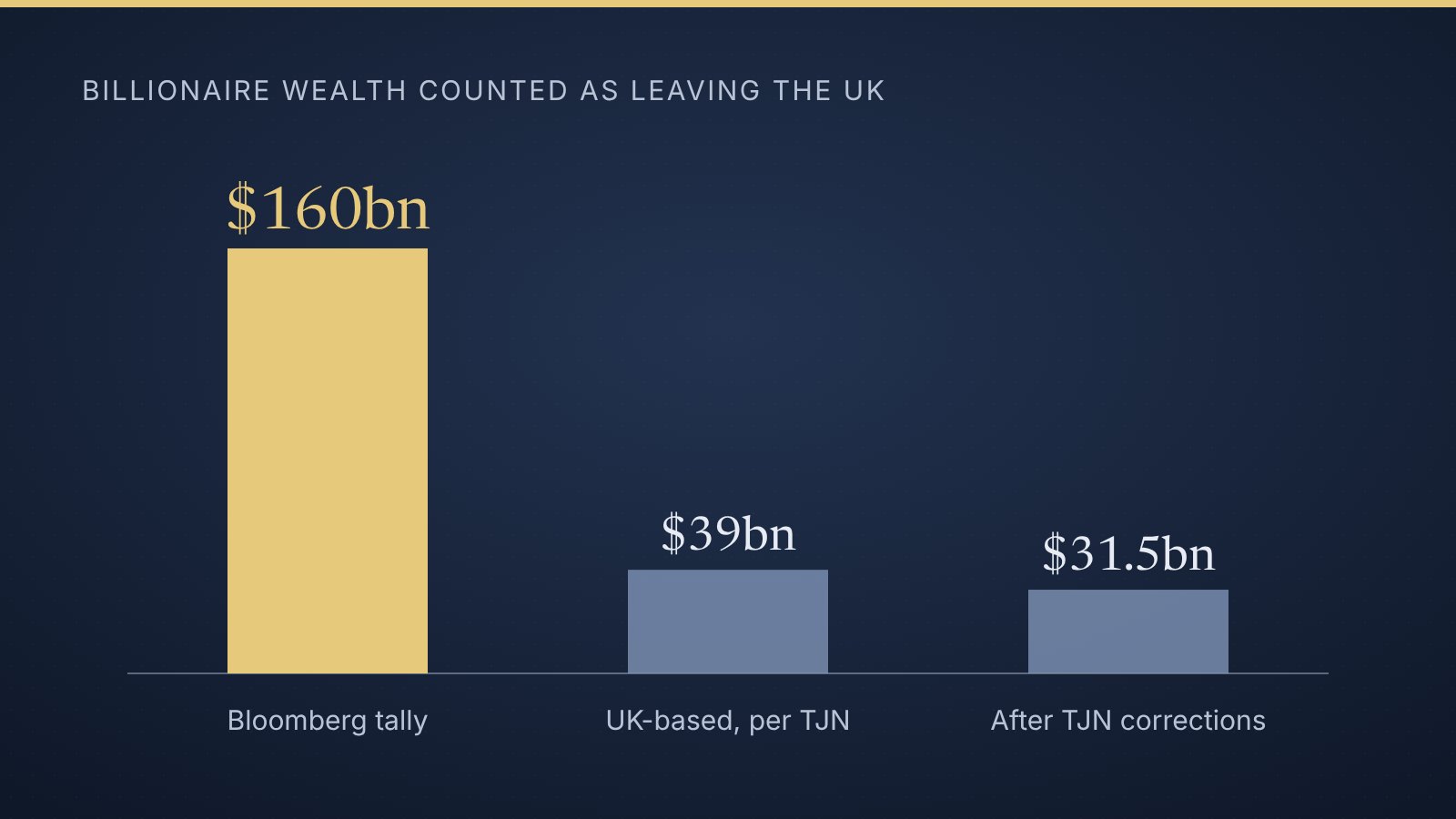
Billionaires who left Britain or loosened their ties to it over the past two years are worth about $160 billion together, according to a Bloomberg analysis published on 4 October 2026 and reported by Gulf News, City AM, The National and Fortune. On 19 October the Tax Justice Network (TJN), a campaign group, published a review arguing that half of the 14 entries it examined on Bloomberg’s “Moving out” list do not fit.
“The rich will leave” is the central argument in every fight over taxing wealth. This post sets out both sides and explains why where a person lives, where their assets sit and where they pay tax are three separate questions.
Where the $160bn Figure Comes From
We have not read Bloomberg’s article; this account relies on outlets that reported it. Using its Billionaires Index, Bloomberg added up the wealth of billionaires and other very rich people, plus some family fortunes, who left Britain or significantly loosened their ties over two years, Gulf News reported. Gulf News and Fortune said it exceeds the wealth of the billionaires who stayed, and Gulf News noted that it does not mean $160 billion in cash physically left.
Gulf News reported that half of the group left in the weeks before the April 2025 tax changes. Its examples include Shravin Mittal, who has moved to the UAE and opened a branch of his investment firm Unbound there, and Troels Holch Povlsen, who has returned to Denmark. Hedge fund manager Chris Rokos is reported to have moved to Greece, though TJN says he is still UK resident.
What the Tax Justice Network Review Says
Billionaires.Africa, reporting the review, describes TJN as a group that supports higher taxes on the wealthy, so this is one side’s critique.
TJN tested each entry on two conditions: did the person move, or announce a move, within two years, and is the wealth counted theirs alone? As Bloomberg did not define the window, TJN started it in late May 2024, when the general election was called. It says half the entries fail: three on timing or residence, four on whose wealth is counted. In its timing cases, Jeremy Coller left on 6 April 2024 and returned in May 2026, and Bloomberg reported Nassef Sawiris’s move in December 2023.
By TJN’s reading of Bloomberg’s own data, only $39bn (24%) of the $160bn was UK-based to begin with, and $31.5bn (20%) after its corrections. Much of that, TJN says, is hard to move, such as property and two English football clubs.
We found no public response from Bloomberg as of 25 October 2026.
Where You Live, Where Assets Sit, Where You Pay Tax
Residence is where a person lives for tax purposes. The assets may sit elsewhere, such as a fashion group in Denmark or a telecoms company in India, and a move does not, by itself, move them. TJN’s four wealth cases, all its own claims, show how such a total grows:
- Family wealth under one name. TJN says the $23.3bn attributed to Shravin Mittal is the whole family’s wealth, largely owned by his father Sunil, who lives in India and chairs Bharti Airtel. See the Mittals’ listed layers.
- A business run by the next generation. The $5.3bn counted for Troels Holch Povlsen comes from Bestseller, which his son Anders has owned and run since 2001, TJN says.
- Shares held in trust. TJN says much of the $19.2bn credited to John Fredriksen sits in two Cyprus companies owned by trusts, and that 2025 annual reports of Frontline, SFL and Flex LNG say he is neither a beneficiary nor a trustee. A trust separates legal ownership from benefit, as Holding Structures in Plain English explains.
- Valuation gaps. Bloomberg values Mohamed Mansour at $18bn; TJN notes that Forbes estimates $4bn for him and $7.2bn for the three Mansour brothers together.
TJN adds that non-doms were already allowed to pay tax as if they lived abroad.
What Replaced the Non-Dom Regime in April 2025
Under HMRC’s policy paper of 30 October 2024, from 6 April 2025 the remittance basis, which let non-domiciled residents pay UK tax on foreign income and gains only when brought into the UK, was replaced by a regime based on residence. Three parts matter most:
- The 4-year FIG regime. New arrivals who were not UK tax resident in any of the previous 10 consecutive years can claim 100% relief on foreign income and gains (FIG) for their first 4 years of tax residence, HMRC says.
- Inheritance tax by residence. A residence test replaced domicile: after at least 10 of the previous 20 tax years in the UK, a person is a long-term resident, and inheritance tax reaches their foreign assets owned outright.
- The tail. Someone who leaves after 10 to 13 years of residence stays in scope for 3 tax years, plus one for each further year, up to 10, according to HMRC’s inheritance tax manual.
So leaving does not end the UK’s inheritance tax reach at once. Our UK jurisdiction guide sets these rules beside other places.
The Budget on 28 October
The Chancellor will present Budget 2026 to Parliament on Wednesday 28 October 2026, according to GOV.UK. It is the next date to watch; we make no prediction. The same “they will leave” argument is being tested in California’s Prop 40 vote.
A fair caveat
Bloomberg’s own definitions may differ from these reports. TJN’s corrections rest on its chosen window and its reading of filings. Private fortunes are estimates that differ between rich lists, and neither number shows how much tax the UK has gained or lost.
Five lessons to take away
- Residence, assets and tax are three questions. A move answers only the first.
- Family wealth is rarely one person’s. Counting a family’s fortune under one member inflates any tally.
- Trusts separate ownership from benefit. Shares held in trust may not belong to the person named beside them.
- Dates decide who counts. A window drawn differently changes who is said to have left.
- Leaving does not end UK inheritance tax at once. The tail keeps former long-term residents in scope for 3 to 10 years.
Questions to bring to your advisors
If a family member moved country, which of our assets would still be taxed where they sit, and for how long would the old country’s inheritance tax apply? Are our fortunes counted per person, per family or per trust? These are questions to bring to your lawyers and tax advisors, not advice.
