The Medici got rich as bankers. From 1397 their Florence bank made most of its profit from papal business and bills of exchange, run through a network of branch partnerships, and the family turned that money into political power. A free display at London’s Wallace Collection, “Cosimo I de’ Medici: Art and Dynasty”, runs from 18 November 2026 to 21 March 2027 and shows the next stage: how Cosimo I (1519 to 1574) used art to secure a dynasty.
What the Wallace Collection Is Showing
The centrepiece is a wine cooler made in Urbino in 1574, over 70cm tall. It carries Cosimo’s emblem, a turtle with a sail, for his motto “festina lente”, make haste slowly (FAD Magazine). There is also a sword linking him to Hercules and a newly conserved portrait of his wife, Eleonora of Toledo, from Bronzino’s workshop. The museum says they show how Cosimo used art to “strengthen his authority, impress his court, and secure his family’s legacy”. FAD names Julia van Zandvoort as curator.
How the Medici Bank Made Money
The standard account comes from the economic historian Raymond de Roover:
- Start: Giovanni di Bicci de’ Medici founded the bank in Florence in 1397 with 10,000 gold florins.
- Structure: each branch was a separate partnership, with the Florence partnership as majority owner. Managers invested their own money and took a share of profits instead of a salary. De Roover compared it to a holding company.
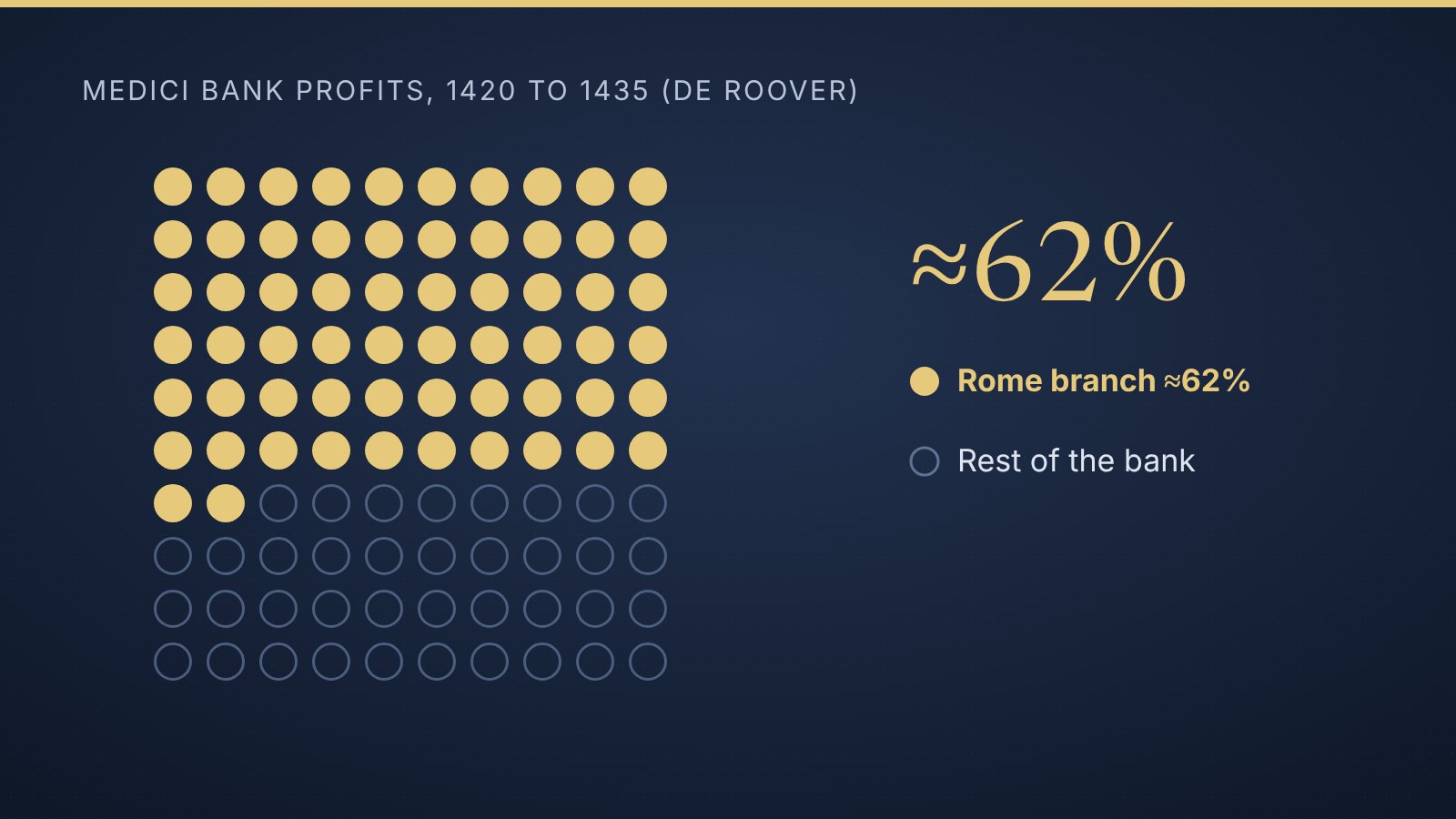
- The Pope’s banker: the Rome branch followed the papal court and held its deposits. From 1420 to 1435 it earned about 62% of the bank’s profits.
- No open interest: the Church banned usury, so profit came mainly from bills of exchange: money bought in one city and paid out in another at a set rate.
Why the Bank Faded but the Family Rose
After Cosimo the Elder died in 1464, supervision slackened, by de Roover’s account. The London and Bruges branches lent heavily to rulers, including Edward IV of England, and were not repaid; London was wound up in 1478 with losses of 51,533 florins. When the Medici were expelled from Florence in 1494, the bank was liquidated.
By then money had become position: Cosimo the Elder had led Florence unofficially from 1434, and two Medici later became popes. Cosimo I came from a branch descended from Cosimo the Elder’s brother Lorenzo, Britannica notes. He was elected head of Florence in January 1537 after his distant cousin Alessandro was murdered, took Siena after a long siege (it surrendered in 1555), and was made Grand Duke of Tuscany by Pope Pius V in August 1569. He built the Uffizi to put government offices under one roof. Compare Beretta’s 500 years in one family.
A fair caveat
The bank’s figures come from incomplete surviving records, and florins do not convert neatly into today’s money. Display details come from the museum and one magazine.
What to watch
- 18 November: the display opens in the Housekeeper’s Room, free.
- The conserved Eleonora portrait, now close in colour to the Uffizi original, the museum says.
- 21 March 2027: the last day.
Questions to bring to your advisors
If our wealth came from one business, what would let it outlast that business? Who checks the managers of our separate entities? These are questions to bring to your advisors, not advice.