Stanley Ho, who built Macau’s casino industry, would have turned 105 on 25 November 2026. Born in Hong Kong in 1921, he won Macau’s gaming monopoly in 1961 and held it for four decades. For families, the most useful part of his story is the handover: in December 2010 his private holding company issued new shares that left him with almost nothing, and he went to court to undo it.
The fight was settled within three months, but the lesson is about structure. Ho’s control sat in one small company, and whoever held its shares held the top of his empire.
How Stanley Ho won the Macau monopoly
Ho bid in Macau’s casino tender of 1961 with partners Henry Fok, Teddy Yip and Yip Hon. Their company was Sociedade de Turismo e Diversões de Macau, or STDM. According to the gaming law scholar Jorge Godinho, its concession began on 1 January 1962 and lasted 40 years and three months.
In the late 1960s Ho built Casino Lisboa. His Hong Kong group, Shun Tak Holdings, ran most ferries between Hong Kong and Macau in 2020, Bloomberg wrote.
The monopoly ended on 31 March 2002, after a public tender for three new concessions. SJM, controlled by STDM, became one of the licence holders, and foreign rivals such as Las Vegas Sands and Wynn Resorts arrived. In 2008 SJM Holdings sold about 25% of its equity on the Hong Kong market, raising the equivalent of $494 million, Inside Asian Gaming (IAG) reported.
A chain of companies: Ho, Lanceford, STDM, SJM
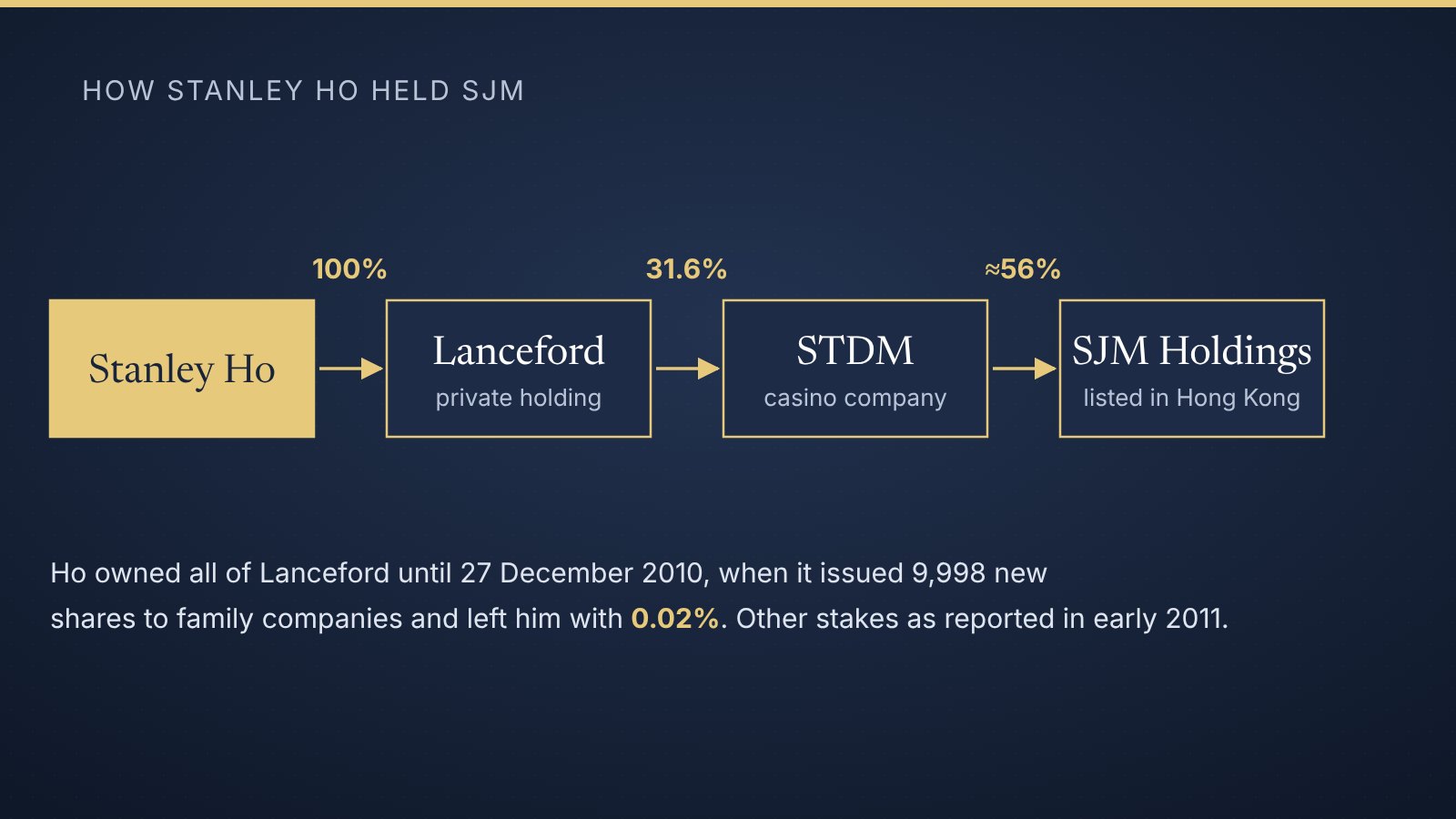
Ho never owned STDM outright. In February 2011 its largest shareholder was Lanceford, a private company holding 31.6%, IAG reported. The Henry Fok Ying Tung Foundation held 27%, after Fok gave it his stake in 2002, and Shun Tak held 11.5%. STDM in turn owned about 56% of SJM, the South China Morning Post (SCMP) reported at the time.
Before the share issue described below, Lanceford was wholly owned by Ho. So Ho’s hold on a listed casino group ran through a chain, and whoever owned the small private company at the top held his place in it. (Our guide to holding companies, trusts and foundations explains how such layers work.)
The December 2010 share issue at Lanceford
On 27 December 2010 Lanceford allotted 9,998 new shares, 99.98% of its enlarged capital, the SCMP reported. They went to two British Virgin Islands companies, Action Winner Holdings (about 50.55%) and Ranillo Investments (about 49.45%), each owned by a different branch of Ho’s family. Ho was left with two shares, or 0.02%. Nothing was sold: issuing new shares was enough to move control.
The change became public in late January 2011. Analysts cited by Reuters said it may have been meant to prepare an orderly succession.
The 2011 lawsuits and how they ended
Instead, there was a fight. Ho’s lawyer, Gordon Oldham, told the SCMP that Ho believed the shares had been “fraudulently misappropriated by members of his family”, and that Ho had signed a document without its effect being explained. In late January a claim was filed in the Hong Kong High Court against family members and companies. According to Reuters, it alleged the shares were “improperly and unlawfully allotted” and sought to reverse the issue. Hours earlier Ho had said on television that he would not sue; Oldham said he had been pressured into saying so. Family members released documents they said showed he had agreed to the transfer.
Relatives said he dropped that claim, which his lawyer disputed. On 16 February he filed a second one naming Pansy Ho and Daisy Ho, who would later chair Shun Tak and SJM; it asked them to undo the December share issue. Ho withdrew it on 21 February. On 8 March a deed of settlement was signed “between all branches of the Ho family”. Its terms were not published. Angela Leong, then managing director of SJM, said the branches would have “balanced participation” in STDM and SJM. Bloomberg later wrote that Ho resolved the dispute by giving up most of his stake.
Who controls SJM now
Ho stayed chairman of SJM Holdings until its annual meeting on 12 June 2018, when he became chairman emeritus. Daisy Ho, an executive director, succeeded him, with Timothy Fok and Angela Leong as co-chairmen.
The next shift came on 23 January 2019. Pansy Ho, an executive director of STDM, companies linked to her, including Lanceford, and the Henry Fok Ying Tung Foundation, led by Timothy Fok, signed an agreement to act together at STDM, according to a Shun Tak filing and the Macau Daily Times. GGRAsia put their combined stake at 53.01% of STDM, which held 54.11% of SJM. Their stated aims included keeping STDM’s majority in SJM. The foundation of a 1961 partner had become part of the controlling bloc.
In June 2026 IAG put STDM’s interest in SJM at 64.11%, including shares pledged to it; GGRAsia had put its outright stake at about 54.81% in March. IAG listed Daisy Ho as chairman in November 2025, and Angela Leong as co-chairman in June 2026. We found no recent public figure for the alliance’s combined stake.
A fair caveat
Much of the 2011 detail comes from reports written during the dispute, often quoting one side’s lawyer. The allegations were never tested in court and the settlement terms were never published, so who gained how much is not known.
Five lessons to take away
- Control sits at the top of the chain. Ho’s empire turned on a small private company that outsiders had barely heard of.
- A share issue can move control without a sale. At Lanceford, 9,998 new shares turned a sole owner into a 0.02% holder.
- A founder’s consent needs a clear record. The dispute turned on what Ho had signed and whether he understood it.
- Partners’ successors matter. Henry Fok’s stake, passed to his foundation, became part of the bloc that held a majority of STDM in 2019.
- Branches need rules before the founder steps back. A written pact such as the Henkel family’s share pool sets out how blocs vote; for another quarrel over who owns what, see the TVS family.
Questions to bring to your advisors
Which company sits at the top of our structure, and who can issue new shares in it? What signed and witnessed consent would a transfer need while the founder is alive? If the family splits into branches, what written agreement says how they vote together? These are questions to bring to your advisors, not advice.