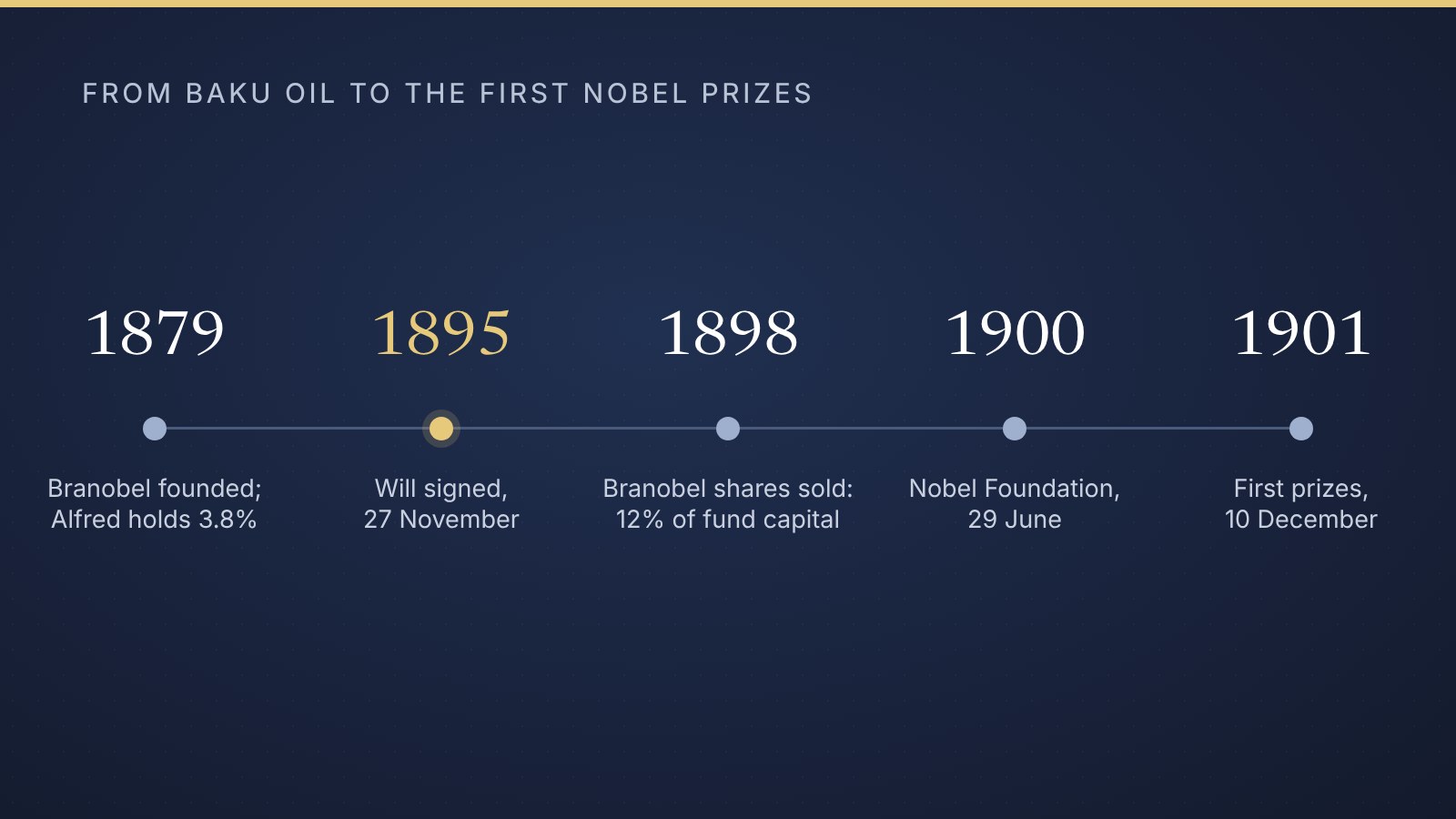
Alfred Nobel’s will, signed in Paris on 27 November 1895, left most of his fortune to a fund whose interest was to pay for five yearly prizes. The estate was worth more than 31 million Swedish kronor, according to the Library of Congress. Most of it came from dynamite. Roughly one kronor in eight came from Baku oil: his shares in Branobel, his brothers’ oil company, matched 12% of the Nobel Foundation’s base capital, according to the Branobel History Project.
Relatives challenged the will, and the first prizes came only on 10 December 1901. This year’s ceremony in Stockholm, on 10 December 2026 (APA), falls 125 years after the first prizes and 130 years after his death.
What Alfred Nobel’s Will Said
Nobel signed his third and last will at the Swedish-Norwegian Club in Paris, nobelprize.org records. First come cash gifts: his nephew Emanuel was to receive 300,000 kronor, nephews Hjalmar and Ludvig 200,000 each, and nieces Mina, Ingeborg and Tyra 100,000 each: 1 million kronor in all, by our calculation. Friends and staff received other sums and annuities.
“All of my remaining realisable assets” were to form a fund. The executors would convert them into safe securities, and the interest would be split into five equal parts: physics, chemistry, physiology or medicine, literature and peace. The will named the bodies to choose the winners and said nationality should not count.
The executors were Ragnar Sohlman of Bofors and Rudolf Liljequist of Stockholm, paid 100,000 and 50,000 kronor for the work. Sohlman, his assistant since 1893, was 25 (our calculation from Wikipedia).
Where the Money Came From: Dynamite and Baku Oil
Nobel’s fortune came mostly from dynamite, according to Wikipedia and a 2007 AFP report.
In 1874 Robert Nobel bought a refinery and land in Baku, the Branobel History Project’s timeline says, and in 1878 came the Zoroaster, which it calls the world’s first tanker. In 1879 Ludvig, Robert and Alfred Nobel, Peter Bilderling and others formed a limited company with 3 million roubles of share capital. Wikipedia gives the split: Ludvig 53.7%, Baron Peter von Bilderling 31.0%, Alfred 3.8% and Robert 3.3%.
By 1902 Branobel produced about 10% of the world’s oil, the timeline says. Wikipedia, citing a 2019 book, counts over 500 wells and 150 million barrels from 1877 to 1901.
In 1898 Emanuel bought Alfred’s Branobel shares, which corresponded to 12% of the foundation’s base capital, the timeline says; Wikipedia also gives about 12%. No source we found splits the other 88%.
Those shares had left his estate well before Russia nationalised its oil industry in June 1918. In 1920 Standard Oil of New Jersey bought half of Branobel’s shares on 30 July (timeline), or almost half of the family’s shares in May (Wikipedia), at a price neither gives. See our post on Standard Oil’s founder.
How the Estate Became the Nobel Foundation
First, there was no legal body to receive the money. The two executors, neither a lawyer, had to create one (Library of Congress). Nobel had not asked the prize-giving institutions whether they would serve (AFP). His family opposed the prize, and the awarders he named at first refused, nobelprize.org says.
Second, his domicile was unclear. He had homes in Paris and at Bofors in Sweden, and most of his assets, mostly bonds, were in France. A Swedish court found Sweden was his domicile, partly because he had moved his horses there, so Swedish law governed the will (Library of Congress).
Third, the family. Emanuel, whose 300,000 kronor was the largest gift to a relative, backed the will. Brita Åsbrink writes that he carried it through against Robert’s family, the institutions and King Oscar II. An agreement with Robert Nobel’s heirs followed in 1898 (Wikipedia, citing a 1972 history). Most relatives apparently settled and received 6% of the estate, according to the Library of Congress. Wikipedia, citing the Nobel Foundation, says 94% of his assets, about 31 million kronor, went to the prizes.
The Nobel Foundation was established on 29 June 1900 by a special statute that included the settlement with the relatives. Our plain-English guide compares foundations, trusts and holding companies.
A fair caveat
Figures vary: AFP in 2007 gave about 31.5 million kronor for the foundation. The 12% Branobel share comes from the Branobel History Project and Wikipedia, not from a Nobel Foundation document we could open. The 1920 accounts differ on the date and on whose shares were sold.
Five lessons to take away
- A purpose needs a vehicle. Nobel named a fund but no entity to hold it.
- Executors carry the weight. Sohlman, named at 25 and not a lawyer, spent years building the foundation.
- Domicile decides which law applies. A court, not Nobel, settled which country’s rules governed his will.
- One family ally can matter. Emanuel’s backing helped turn a challenge into a settlement.
- A foundation need not keep the family business. Nobel’s estate sold his oil shares, unlike the Carl Zeiss Foundation, which owns ZEISS.
Questions to bring to your advisors
Which country’s succession law would apply to us, and would a court agree? If we leave assets to a purpose, does a body exist to receive them? Who would carry it out, with what time and skill? How might relatives who expect more respond, and what would a settlement cost? These are questions to bring to your advisors, not advice.