The Disney family still owns shares in The Walt Disney Company, but only a small slice: less than 3%, according to Roy P. Disney, grandson of co-founder Roy O. Disney, in a 2019 Business Insider profile. By his account, Walt and Roy O. Disney owned about 20% of the company by 1960. The family no longer controls the business that carries its name.
Walt Disney was born on 5 December 1901, so 5 December 2026 is his 125th birthday. D23, the company’s official fan club, is marking the year as “Walt Disney: 125 Years of Inspiration”. For family wealth, the useful part of the story is Retlaw, the private company Walt kept beside the public one, and how the public company finally bought it out with its own shares.
How the Disney Family’s Stake Fell From 20% to Under 3%
A founding family’s percentage can shrink in two ordinary ways. Family members sell or give away shares, and the company issues new shares, for example to raise money, so every existing holder owns a smaller slice even if they sell nothing.
The first kind is on record. Business Insider, citing The Wall Street Journal, reported that in 2003 Walt’s nephew Roy E. Disney planned to sell 7.5 million shares, about 43% of his stake. Spread over branches and generations, such holdings become many separate portfolios, not one controlling block. Unlike the Fords, who kept a fixed share of the votes through special shares (we compared the Ford and Hewlett families), the Disneys held ordinary shares, so each sale and each new share issue reduced their voice. Selling down also cuts the risk of keeping most of a fortune in one company.
What Was Retlaw, Walt Disney’s Private Company?
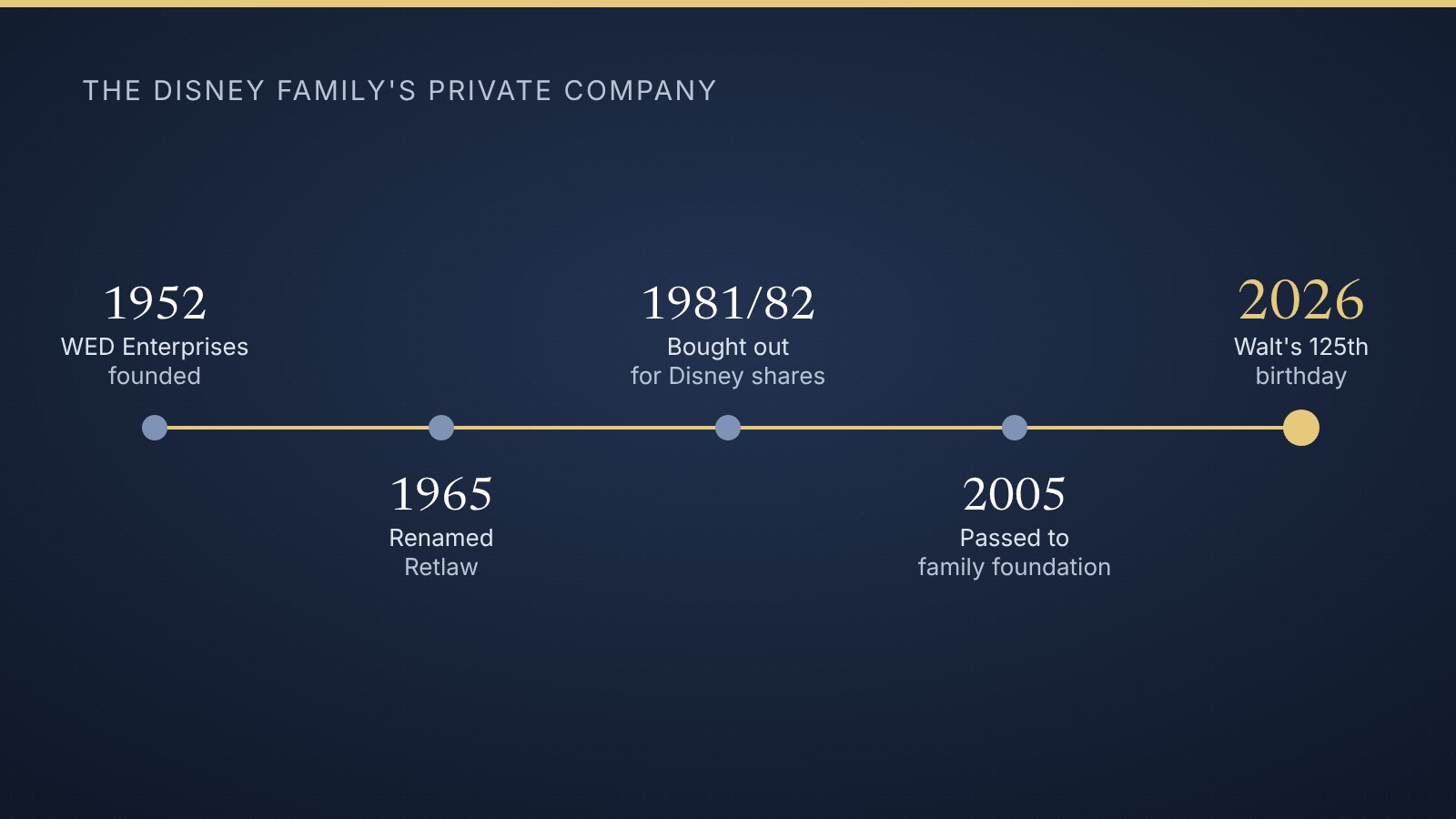
According to D23’s archive, Walt founded WED Enterprises in 1952 to handle his family’s interests, mainly the design and building of Disneyland. The name came from his initials, Walter Elias Disney. In 1965 Walt Disney Productions bought WED from Walt, and he created Retlaw, “Walter” spelled backwards, to carry on handling the family’s interests.
Retlaw held assets that a shareholder might have expected to sit inside the public company:
- the rights to Walt Disney’s name and likeness;
- the Disneyland Railroad and the Disneyland Monorail, which belonged to Walt’s company rather than to the park.
D23 says Roy O. Disney worried in the early 1960s that stockholders would complain about the intertwined dealings between Walt, his company and the studio, and that the brothers argued about it.
Why a Founder’s Side Company Becomes a Problem
The conflict is simple arithmetic. Walt’s family owned all of the private company but only part of the public one. Every dollar a Disneyland ride earned for Retlaw went to the family alone. The same dollar earned by Walt Disney Productions would have been shared with every shareholder. When one person stands on both sides of a deal, the price and terms are open to question even if they are fair.
The sums were not small. SEC filings cited in later accounts, including a 1990 Los Angeles Times report, put Retlaw’s income from the railroad and monorail at $75 million between 1955 and 1981. In today’s language these are related-party transactions: deals between a company and the people who control it. In the US, listed companies must now disclose them, and independent directors are expected to review them.
The Buyout: Retlaw Sold for Disney Shares
The answer was to bring the assets inside. Ken Polsson’s independent chronology of the company records that on 9 July 1981 Walt Disney Productions bought out Retlaw for $46.2 million in Disney stock, gaining the rights to Walt’s name and Disneyland’s monorail and steam railroad. Other accounts, including Wikipedia citing a 1990 Los Angeles Times report, date the transaction to 1982 and value the payment, 818,461 shares, at $42.6 million. The sources agree on payment in shares, not on the date and value.
Two details matter for families. First, according to these accounts, the shares went to the Disney family members who owned Retlaw rather than to Retlaw itself. Second, Roy E. Disney, then a Disney director, reportedly voted against the deal, arguing the price was too high. A family seat on the board does not mean the family speaks with one voice.
After the buyout Retlaw kept its television stations and later sold them, in a sale of 11 stations to Fisher Companies agreed in 1998 and reported at $215 million. In 2005, the accounts say, what remained passed to the Walt Disney Family Foundation, the nonprofit behind the Walt Disney Family Museum in San Francisco.
Walt Disney at 125: What Is Left of the Family Link
The company now celebrates Walt’s anniversary, and the Walt Disney Family Museum has held birthday events for him on 5 December. The ownership link is much thinner. The stock paid for Retlaw added to the family’s holding in 1981 or 1982, but four decades of sales and dilution have left a stake of under 3% by the family’s own estimate. Our post on holding companies, trusts and foundations explains the tools other families use to keep a block together.
A fair caveat
The “less than 3%” figure is an estimate given by a family member in 2019, not a number from a filing, and it covers many separate holders. The Retlaw numbers come from secondary accounts citing SEC filings and press reports we could not open ourselves, and they disagree on the date and value of the buyout.
Five lessons to take away
- A founder’s side company creates a conflict. Every deal between it and the main company is a deal with yourself.
- The fix is often to fold it in. Disney paid for Retlaw in shares, turning private income into public stock.
- Ordinary shares dilute quietly. Without special voting shares or a pooling agreement, a family’s voice erodes.
- Family directors may disagree. Roy E. Disney’s vote shows a seat on the board is not a family bloc.
- Foundations can outlast the stake. The Disney name lives on in a family foundation and museum.
Questions to bring to your advisors
Do we own any assets privately that our operating company uses or pays for, and how would an outside shareholder see those deals? If we wanted to bring them inside, would we be paid in cash or shares, and what would that do to our stake? Without special shares or a shareholder agreement, how fast could our voting power fall? These are questions to bring to your advisors, not advice.