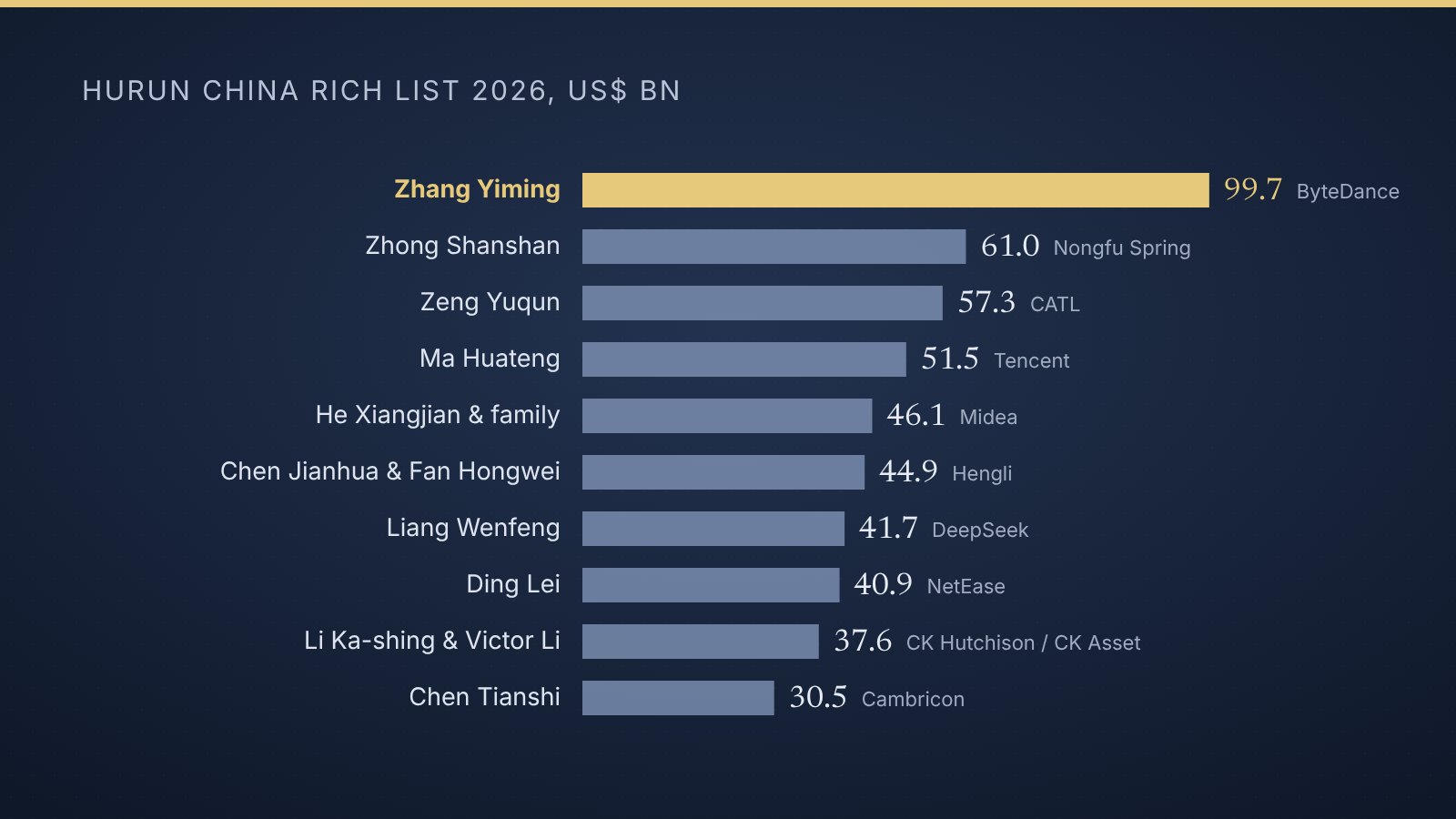
ByteDance founder Zhang Yiming is the richest person in China in 2026, with $99.7bn, according to the Hurun China Rich List published on 27 October. It is his second time at the top, and Hurun links the gain to ByteDance’s push into artificial intelligence. The 28th edition counts a record 1,529 people worth at least 5 billion yuan (about $740 million), with combined wealth of $4.8 trillion, up 7%.
All figures are Hurun’s estimates as of 1 September 2026, converted at 6.72 yuan to the dollar. For families, two things stand out: new fortunes come from AI, chips and robots, and almost every young fortune is inherited.
Hurun China Rich List 2026: The Top 10
Joint entries keep Hurun’s wording. Percentage changes are Hurun’s, calculated in renminbi.
| Rank | Name | Company | Wealth (US$ bn) | Change |
|---|---|---|---|---|
| 1 | Zhang Yiming | ByteDance | 99.7 | +43% |
| 2 | Zhong Shanshan | Nongfu Spring | 61.0 | -23% |
| 3 | Zeng Yuqun | CATL | 57.3 | +17% |
| 4 | Ma Huateng | Tencent | 51.5 | -26% |
| 5 | He Xiangjian & family | Midea | 46.1 | +12% |
| 6 | Chen Jianhua & Fan Hongwei | Hengli | 44.9 | +59% |
| 7 | Liang Wenfeng | DeepSeek | 41.7 | New |
| 8 | Ding Lei | NetEase | 40.9 | -14% |
| 9 | Li Ka-shing & Victor Li Tzar Kuoi | CK Hutchison / CK Asset | 37.6 | +8% |
| 10 | Chen Tianshi | Cambricon | 30.5 | +14% |
Together the top 10 hold about $511bn, by our sum of Hurun’s figures. Lei Jun of Xiaomi, Huang Zheng of Pinduoduo, and Eric Li Shufu and family of Geely dropped out.
Why the Order Changed: ByteDance Up, Nongfu Spring Down
Hurun’s reasons for the big moves:
- ByteDance, up. Hurun ties Zhang’s rise to the company’s “aggressive push into AI”. Zhang, 43, added $33.8bn and heads Hurun’s list of the year’s fastest risers.
- Nongfu Spring, down. Zhong Shanshan slipped to second as Nongfu Spring’s shares fell 17% from last year’s peak, despite record 2025 profits.
- Tencent, down. Ma Huateng’s fortune fell as Tencent’s shares pulled back after last year’s AI-driven rally.
- Hengli, up. The market re-rated the group after its shipbuilding arm won the world’s largest single-yard order book.
- Xiaomi, down. Lei Jun lost $20.6bn, the year’s biggest fall in dollar terms, on heavy spending on Xiaomi’s car business and a lower share price.
DeepSeek’s Liang Wenfeng and the AI Newcomers
DeepSeek founder Liang Wenfeng, 41, enters at seventh with $41.7bn. Hurun says he funded DeepSeek himself in 2023, with no outside venture capital, and that the market priced the lab this year at more than $50bn. Chen Tianshi, also 41, of the AI chipmaker Cambricon, joins the top 10 with $30.5bn.
Wang Xingxing, 36, of the humanoid-robot maker Unitree, debuts at 78th with $10.3bn after Unitree’s August listing. Hurun counts 263 new names in all, and says 10.4% of the list is now active in AI.
Rupert Hoogewerf, Hurun’s chairman, called it “a two-speed economy”: AI, chip and robotics founders surged while consumer, property and traditional manufacturing fortunes shrank. For the first time, no mainland property developer is in the top 100. Shenzhen leads the city count for the first time, with 177 people, ahead of Shanghai (161) and Beijing (140); Hong Kong passes 100 for the first time, with 102.
Heirs on the List: What Hurun’s Age Figures Show
The average age on the list is 61. The oldest self-made entrepreneur on the list is Li Ka-shing, at 98; the youngest is Zhang Junjie, 31, founder of the tea-drinks chain Chagee. At the young end, as Hurun states it:
- all 10 people under 30 are inheritors, and none is self-made;
- of the 59 under 35, just six are self-made, led by Yang Zhilin, 33, of Moonshot AI;
- 98 of those under 40 are second-generation inheritors.
In Hurun’s words, Chinese family wealth has “entered a phase of large-scale inheritance”. The release does not say how many of the 1,529 inherited their wealth, or how many entries are couples or families. In the top 10, three are joint: He Xiangjian and family, Chen Jianhua and Fan Hongwei, and Li Ka-shing with his son Victor Li Tzar Kuoi. Hurun does not explain how it splits holdings within one entry.
This is a handover under way, not a future one, and the hard part is preparation. Our post on how families prepare heirs covers the usual tools, and Sun Life Asia’s new figures on family business succession look at Hong Kong and Singapore. Hong Kong has also seen what an unclear handover costs: Stanley Ho’s casino empire passed on through a share issue he challenged in court before a family settlement.
How Hurun Puts a Number on a Fortune
A rich-list figure is the researcher’s value of a person’s stakes on one date: Hurun calls its list a snapshot as of 1 September, with material changes up to publication. Listed stakes move with share prices; private companies such as ByteDance and DeepSeek are valued by comparison with listed equivalents. At 6.72 yuan to the dollar, Zhang’s $99.7bn is roughly 670 billion yuan (our conversion). Because Hurun measures changes in renminbi, a comparison with last year’s dollar figures can give a different percentage. Our rich-list pages, including India’s, use Forbes and Hurun figures the same way.
A fair caveat
Every number here is a Hurun estimate, not an audited figure, and share prices have moved since 1 September. Private company values rest on comparisons with listed peers, not on a daily share price. Other rankings use other dates and methods, so figures differ between lists.
Five lessons to take away
- A rich-list figure is a snapshot. It reflects prices on one day, here 1 September 2026.
- Concentration drives the swings. Most top-10 fortunes rest on one company, so a single share price can move billions.
- Private valuations are estimates. ByteDance and DeepSeek have no daily share price.
- The handover is already happening. Every under-30 on the list inherited, and 98 of the under-40s are second generation.
- Joint entries need clear rules. When a couple or family shares a fortune, the documents behind it decide who controls what.
Questions to bring to your advisors
How much of our wealth depends on one share price or one private valuation? Which heirs will hold the shares, and who will hold the votes? Is the split between family members written down? These are questions to bring to your advisors, not advice.