Abdul Latif Jameel, the mobility, energy and finance group founded in Saudi Arabia in 1945 and now active in more than 35 countries, is the largest family business in the Arab world on Forbes Middle East’s Top 100 Arab Family Businesses 2026 list, ahead of the UAE’s Al-Futtaim and Egypt’s Mansour Group. The list came out on 19 June. Its companies were honoured at the first Forbes Middle East Family Business Summit, a two-day event in Abu Dhabi on 28 and 29 October.
Read closely, the ranking also shows how these families hold their businesses and where the handover to the next generation stands.
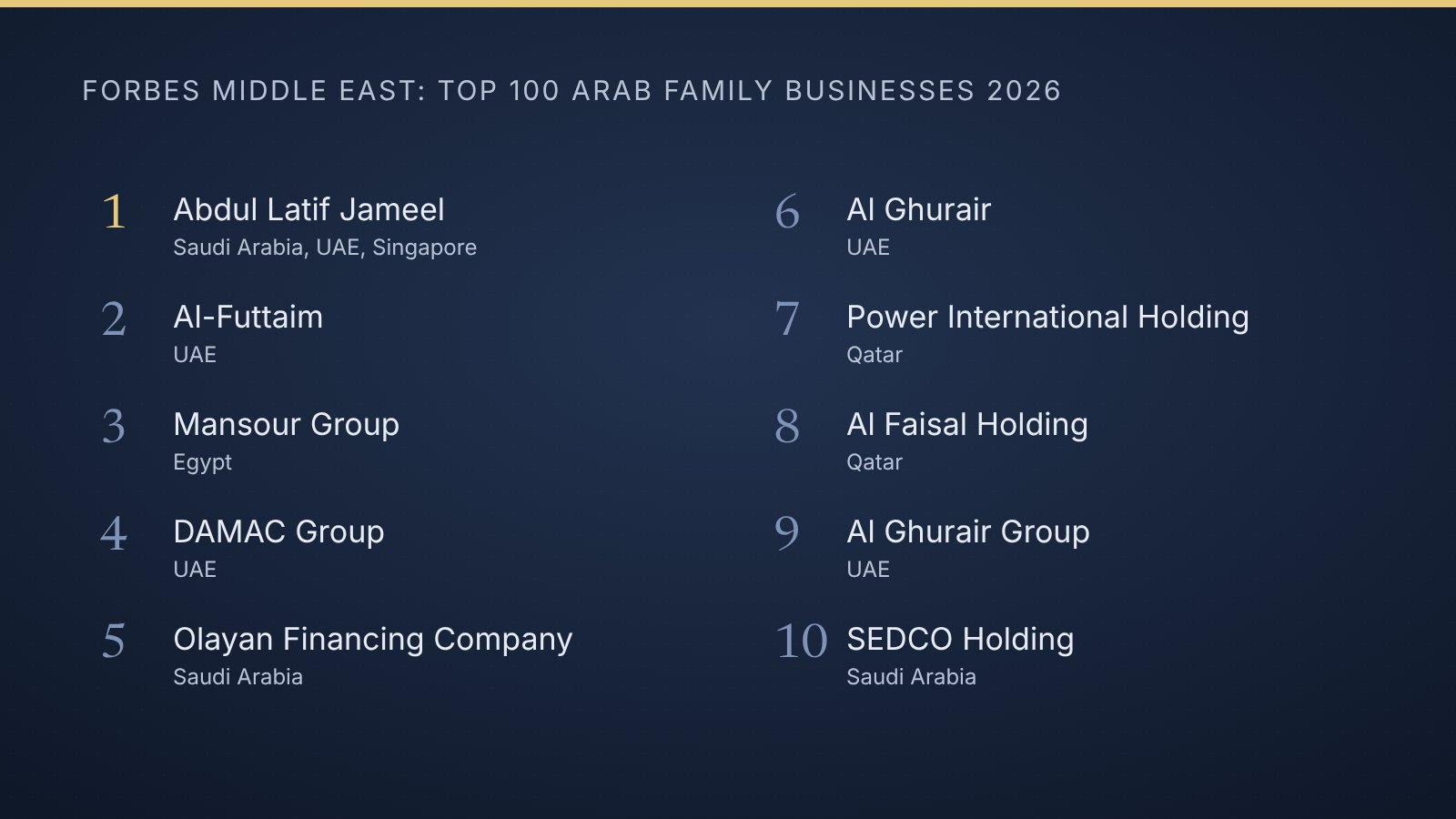
The Top 10 Arab Family Businesses in 2026
Order and wording follow Forbes Middle East.
| Rank | Group | Country | Founded | Leader named by Forbes |
|---|---|---|---|---|
| 1 | Abdul Latif Jameel | Saudi Arabia, UAE, Singapore | 1945 | Mohammed Abdul Latif Jameel, chairman |
| 2 | Al-Futtaim | UAE | 1930 | Omar Al Futtaim, vice chairman and CEO |
| 3 | Mansour Group | Egypt | 1952 | Mohamed Mansour, chairman |
| 4 | DAMAC Group | UAE | 1982 | Hussain Sajwani, founder and chairman |
| 5 | Olayan Financing Company | Saudi Arabia | 1947 | Lubna S. Olayan, deputy chair |
| 6 | Al Ghurair | UAE | 1960 | Abdul Aziz Al Ghurair, chairman |
| 7 | Power International Holding | Qatar | 2011 | Moutaz and Ramez Al-Khayyat |
| 8 | Al Faisal Holding | Qatar | 1964 | Faisal Bin Qassim Al Thani, founder and chairman |
| 9 | Al Ghurair Group | UAE | 1960 | Iyad Malas, group CEO |
| 10 | SEDCO Holding | Saudi Arabia | 1976 | Yaser Binmahfouz, executive chairman |
How Forbes Middle East Ranks Family Businesses
This is not a revenue table or a rich list. According to the Zawya press release, Forbes Middle East looked at companies owned or managed by Arab families and weighed the size and value of their assets, business performance, recent activity, age and legacy, and how widely they spread across sectors and countries.
That mix explains some surprises. Hussain Sajwani’s net worth, $15.3 billion by Forbes’s May 2026 estimate, is the highest given in any top 10 profile, yet DAMAC ranks fourth. Power International Holding, founded in Qatar only in 2011, sits seventh; its profile cites large deals such as a $4 billion Damascus airport concession. Age counts, but so does activity.
Why Al Ghurair Appears Twice
Two UAE entries share the family name and the founding year, 1960, but Forbes profiles them separately:
- Al Ghurair (No. 6) is chaired by Abdul Aziz Al Ghurair. Its units range from food to mobility and infrastructure, with more than 28,000 employees in eight countries. Forbes puts the net worth of Abdulla bin Ahmad Al Ghurair and family at $4.5 billion.
- Al Ghurair Group (No. 9) was founded, in Forbes’s words, by the late Saif Al Ghurair. It is led by group CEO Iyad Malas and works in industry, real estate and investments.
Both profiles cite a stake in Mashreq, the Dubai-listed bank: 32% for the first and 42.2% for the second. Forbes does not explain how they relate. The plain reading is that two separate groups now carry one family name, a common outcome once a business passes to several branches.
Where the 100 Companies Come From
The Gulf dominates. The press release counts 86 entries from the Gulf states, including 32 from Saudi Arabia, 31 from the UAE and 10 from Qatar. Kuwait’s Arab Times, citing the Al-Seyassah daily, counted six Kuwaiti groups, led by Alghanim Industries at 15th and Alshaya Group at 20th. Egypt’s Mansour Group is the only top 10 entry from outside the Gulf; the list also includes groups from Jordan, Morocco, Lebanon and Algeria.
The oldest company on the list is Oman’s Towell Group, founded in 1866. For the people behind the companies, see our pages on the richest families in the UAE and the richest families in Saudi Arabia.
What the Summit Added
According to the organiser’s press release, as carried by mid-east.info on 28 October, the summit ran under the theme “Where Generations Build Tomorrow”, with more than 60 speakers and around 3,000 expected participants. A ceremony honoured companies from the list. A “Successors Forum” over both days discussed the next generation’s readiness for leadership and ownership, family relationships and reputation.
What the List Shows About Ownership and Succession
The top 10 shows three stages of family ownership side by side:
- Founders still in charge. Sajwani at DAMAC (1982) and Faisal Bin Qassim Al Thani at Al Faisal Holding (1964) are both described as founder and chairman.
- The next generation in the top job. At Al-Futtaim, Forbes names Omar Al Futtaim as vice chairman and CEO, with his father Abdulla as owner. At Mansour Group, founded by the late Loutfy Mansour, Forbes says Mohamed Mansour and his brothers Yasseen and Youssef share ownership. We wrote about a younger Mansour’s Palm Hills stake in October.
- Managers and holding layers. At Al Ghurair Group, Forbes names a group CEO, Iyad Malas, rather than a family chairman. Olayan Financing Company is, in Forbes’s words, the parent of the Olayan Group’s business in Saudi Arabia, the Middle East, Türkiye and India (see our Olayan family office page).
Several groups also hold listed companies inside a private structure: Al Faisal Holding has a majority stake in Qatar-listed Aamal Company, and PIH’s subsidiaries include Baladna and Estithmar Holding. The parent stays private while key assets trade on an exchange.
A fair caveat
The ranking is Forbes Middle East’s own judgement, based on criteria it lists but does not weight in public, so the order between neighbours should not be read too precisely. Net worth figures are Forbes estimates as of May 2026. The summit details come from the organiser’s press release.
Five lessons to take away
- Size is not the same as wealth. DAMAC’s founder has the largest net worth cited in the top 10, yet ranks fourth.
- One family name can become two groups. Al Ghurair shows branches with separate managements and stakes.
- Holding companies sit at the top. Olayan and Al Faisal show a private parent above businesses and listed stakes.
- Owning and running can be separate jobs. A group CEO can run a business the family still owns.
- Succession is now discussed in public. A summit forum on successors puts the handover on the agenda.
Questions to bring to your advisors
If our business were split between branches tomorrow, who would own which assets and vote our listed shares? Does our structure separate ownership from management? Do we have written rules for how the next generation joins? These are questions to bring to your advisors, not advice.